
Picking the right shipping box feels small, but it changes everything. The right box keeps your product safe, saves you money, and makes your customers smile when their order arrives in perfect shape. The wrong box? It can mean damaged goods, surprise fees, and a return you did not want.
Good news: once you understand shipping box packaging dimensions, the whole process gets easy. This guide walks you through how to measure a box, how box size affects shipping cost, the standard sizes you can count on, and the smart tips that help you ship with confidence.
Let’s make box sizing one less thing to worry about.
What “Shipping Box Packaging Dimensions” Really Means
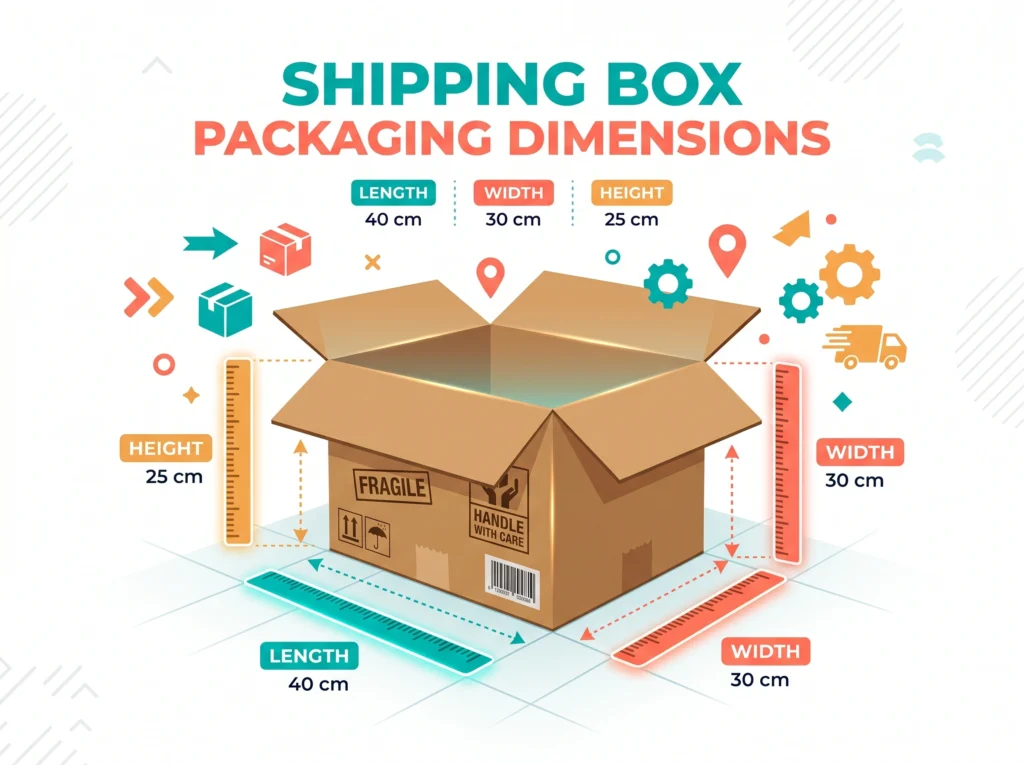
Box dimensions are simply the length, width, and height of your package. They are almost always written in that order: L × W × H.
Here is the easy way to remember it:
- Length the longest side of the box opening
- Width the shorter side of the box opening
- Height how deep the box is from the opening down to the bottom
These three numbers decide how much your product can hold, how well it protects your items, and how carriers like USPS, UPS, and FedEx calculate your rate. That is why dimensions matter just as much as weight when you ship.
Why Box Dimensions Matter More Than You Think
A lot of people focus only on weight. But carriers also look at size, and size can quietly raise your costs. Here is why dimensions are a big deal:
- They control shipping cost. Carriers use something called dimensional weight (more on that soon).
- They protect your product. A box that fits well leaves room for cushioning and prevents items from rattling around.
- They reduce waste. Right-sized packaging uses less filler, less tape, and less cardboard.
- They shape the customer experience. A neat, well-fitted package looks professional and trustworthy.
In short, the right dimensions save money, cut waste, and keep your brand looking sharp.
Also Read: Display Box Packaging Dimensions: The Complete Sizing Guide
How to Measure a Shipping Box (Step by Step)
Measuring a box is quick once you know the routine. Grab a tape measure or ruler and follow these steps.
- Place the box upright with the opening facing up.
- Measure the length the longest side of the top opening.
- Measure the width the shorter side of the top opening.
- Measure the height from the top edge down to the base.
- Round to the nearest inch to match how carriers calculate rates.
Pro tip: Always measure the inside of the box when you want to know if a product will fit, and measure the outside when you are figuring out shipping cost. Carriers charge based on outside dimensions.
Inside vs. Outside Dimensions: Know the Difference
This trips up a lot of new shippers, so let’s keep it clear.
- Inside (interior) dimensions tell you how much space you have for your product and cushioning. Use these when choosing what fits.
- Outside (exterior) dimensions tell carriers how much room your box takes up. Use these for shipping quotes and size limits.
The difference comes from the thickness of the cardboard walls. It is usually small, but for snug items or tight carrier limits, those fractions of an inch add up.
Dimensional Weight Explained (The Fee That Surprises People)
Here is the concept that catches many sellers off guard: dimensional weight, also called DIM weight or volumetric weight.
Carriers charge you based on whichever is greater: the actual weight of your package or its dimensional weight. A big, light box can cost as much to ship as a small, heavy one because it takes up more space on the truck or plane.
The Simple DIM Weight Formula
To find dimensional weight, use this basic formula:
(Length × Width × Height) ÷ DIM Divisor = Dimensional Weight
The DIM divisor changes by carrier and service, but a common number is 139 for domestic shipments measured in inches.
Example: A box that is 12 × 12 × 12 inches:
- 12 × 12 × 12 = 1,728 cubic inches
- 1,728 ÷ 139 = about 12.4, rounded up to 13 lbs of dimensional weight
If your actual package only weighs 4 lbs, you still pay for 13 lbs. That is why right-sizing your box is so powerful.
Standard Shipping Box Sizes Chart
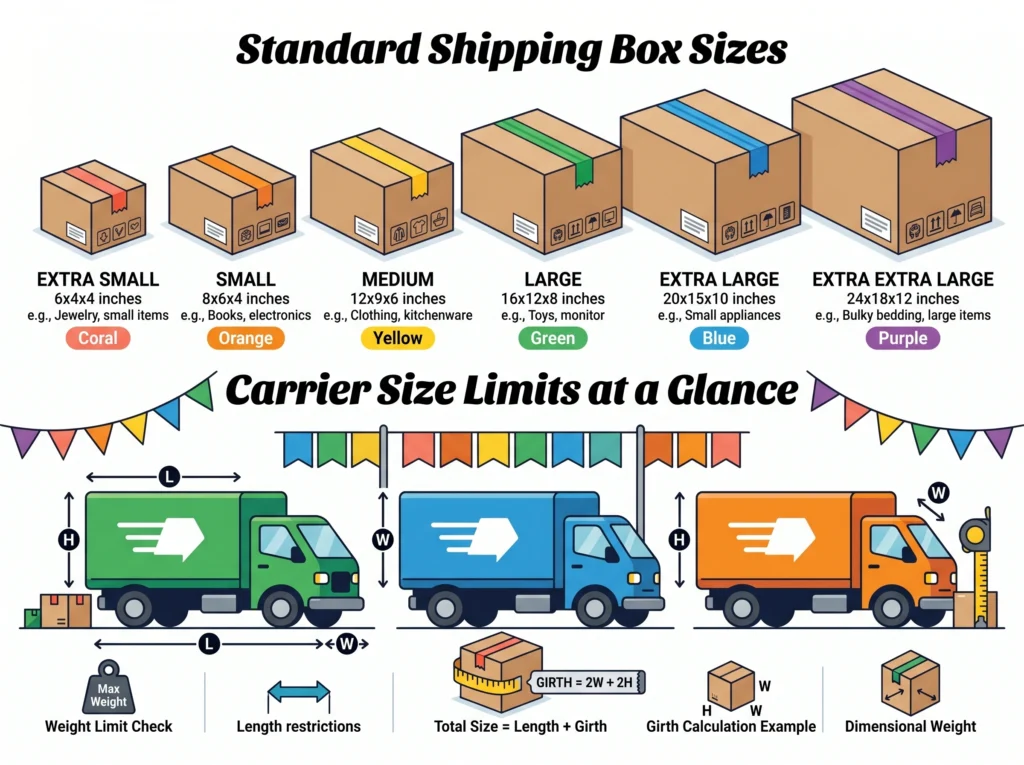
Most products fit into a handful of go-to sizes. Use this chart as a quick reference when choosing packaging.
| Box Size Name | Dimensions (L × W × H) | Common Uses |
|---|---|---|
| Extra Small | 6 × 4 × 4 in | Jewelry, accessories, small electronics |
| Small | 8 × 6 × 4 in | Mugs, candles, phone cases |
| Medium | 12 × 9 × 6 in | Books, apparel, kitchen items |
| Large | 16 × 12 × 8 in | Shoes, multiple items, gift sets |
| Extra Large | 20 × 14 × 10 in | Bulky goods, bundled orders |
| Cube | 12 × 12 × 12 in | Tall or square products |
These are starting points. Many businesses choose custom boxes when their products do not match standard sizes, which cuts down on wasted space and filler.
Carrier Size Limits at a Glance
Each carrier sets limits on how big your package can be before extra fees kick in. Here is a simple comparison to keep handy.
| Carrier | Max Package Size (Length + Girth) | Oversize Notes |
|---|---|---|
| USPS | 130 in (Retail Ground) | Fees rise sharply past standard limits |
| UPS | 165 in | Large package surcharge over 96 in length |
| FedEx | 165 in | Oversize charge applies past set thresholds |
Quick tip: Girth is the distance around the thickest part of your package. The formula is 2 × (Width + Height). Add that to the length to check carrier limits.
How the Right Box Size Saves You Money
Right-sizing is one of the easiest ways to lower shipping costs. Here is how a well-fitted box pays off:
- Lower dimensional weight means smaller carrier charges.
- Less filler material means lower packing costs.
- Fewer damaged items means fewer refunds and replacements.
- Lighter packages can drop you into a cheaper weight bracket.
- Better truck space sometimes earns volume discounts.
A box that hugs your product is a quiet money-saver on every single order.
Common Box Sizing Mistakes to Avoid
Even experienced shippers slip up. Watch out for these:
- Choosing a box that is too big. Empty space costs money and lets items shift.
- Going too small. Cramped products get crushed and cannot be cushioned.
- Forgetting cushioning room. Always leave about 2 inches on each side for padding on fragile goods.
- Mixing up inside and outside dimensions. Use the right one for the right job.
- Ignoring girth. A long, thin package can hit oversize limits fast.
Avoiding these keeps your shipments safe and your costs predictable.
Choosing the Best Box for Your Product
Different products call for different packaging choices. Match your item to the right approach:
- Fragile items (glass, ceramics): snug box with extra cushioning room
- Apparel and soft goods: lightweight boxes or mailers
- Heavy items (tools, books): smaller, sturdy double-wall boxes
- Multiple products: a medium or large box with dividers
- Odd shapes: custom-sized boxes that match the product exactly
When standard sizes leave too much empty space, brands like ONO Custom Boxes offer made-to-fit packaging that trims waste and protects products better.
Frequently Asked Questions (FAQs)
What order do box dimensions go in?
Box dimensions are listed as Length × Width × Height (L × W × H). Length is the longest side of the opening, width is the shorter side, and height is the depth.
Should I measure inside or outside dimensions?
Measure inside dimensions to check if your product fits. Measure outside dimensions for shipping quotes and carrier size limits, since carriers charge based on the exterior.
What is dimensional weight?
Dimensional weight is a pricing method that charges based on the space a package takes up, not just its actual weight. You pay for whichever number is higher.
How do I calculate dimensional weight?
Multiply length × width × height, then divide by your carrier’s DIM divisor (often 139 for domestic inches). Round up to the nearest pound.
What are the most common shipping box sizes?
Popular sizes include 8 × 6 × 4 in (small), 12 × 9 × 6 in (medium), and 16 × 12 × 8 in (large). A 12 × 12 × 12 in cube is also widely used.
How much extra room should I leave for cushioning?
For fragile items, leave about 2 inches of space on each side to fit protective padding like bubble wrap or air pillows.
Do bigger boxes always cost more to ship?
Often, yes. A large, light box can trigger dimensional weight charges, so it may cost the same as a heavier, smaller package. Right-sizing keeps costs down.
What is girth and why does it matter?
Girth is the distance around the thickest part of the package, found with 2 × (Width + Height). Carriers add girth to length to decide if a package is oversized.
Quick Checklist Before You Ship
Run through this list every time to ship smart:
- Measured length, width, and height in L × W × H order
- Used inside dimensions to confirm the product fits
- Used outside dimensions for the shipping quote
- Calculated dimensional weight
- Left room for cushioning on fragile items
- Checked carrier size and girth limits
- Chose the smallest box that protects the product
Final Thoughts
Shipping box packaging dimensions do not have to be confusing. Once you know how to measure a box, understand dimensional weight, and pick the right size, you protect your products, control your costs, and create a better experience for your customers.
The key takeaway is simple: the best box is the smallest one that keeps your product safe. Right-size your packaging, double-check your dimensions, and every shipment will go out looking professional and arriving in great shape.
Measure smart, ship happy, and let your packaging work in your favor.