
Picking the right display box size can make or break how your product looks on a store shelf. If the box is too big, your product slides around and looks lost. If it is too small, it gets crushed or will not close. The good news? Once you understand display box packaging dimensions, choosing the perfect fit becomes simple and fast.
In this friendly guide, you will learn the standard display box sizes, how to measure your product the right way, and the difference between inner and outer dimensions. You will also get a handy size chart, smart tips to save on shipping, and answers to the questions buyers ask most. Let us dive in!
What Are Display Box Packaging Dimensions?
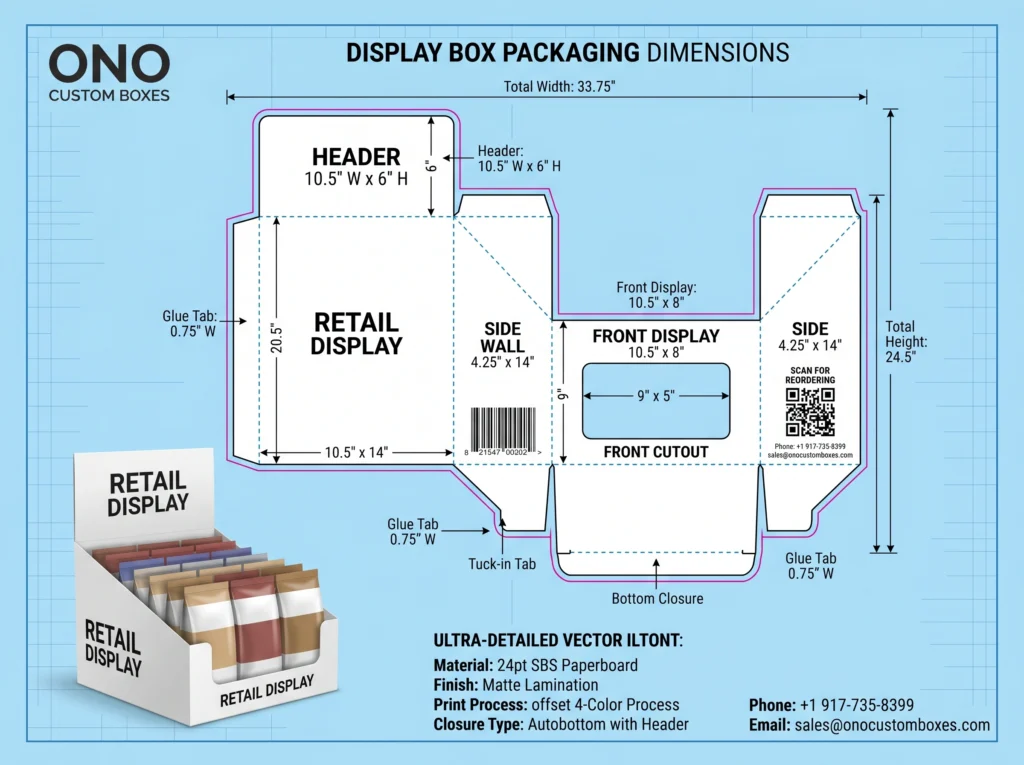
Display box packaging dimensions are the measurements that define a box’s length, width, and height (L x W x H). These three numbers tell you how big the box is and what will fit inside it. They are usually written in inches or millimeters, in this order: length first, width second, height last.
A display box (also called a retail display box, countertop display, or PDQ tray) is designed to hold products and show them off at the point of sale. Think of the small boxes near a checkout counter holding candy, lip balm, or phone chargers. The right dimensions keep your products neat, visible, and easy to grab.
Getting these measurements right matters for three big reasons: your product needs to fit snugly, the box needs to sit well on a retail shelf, and the size directly shapes your shipping and printing costs.
Standard Display Box Sizes
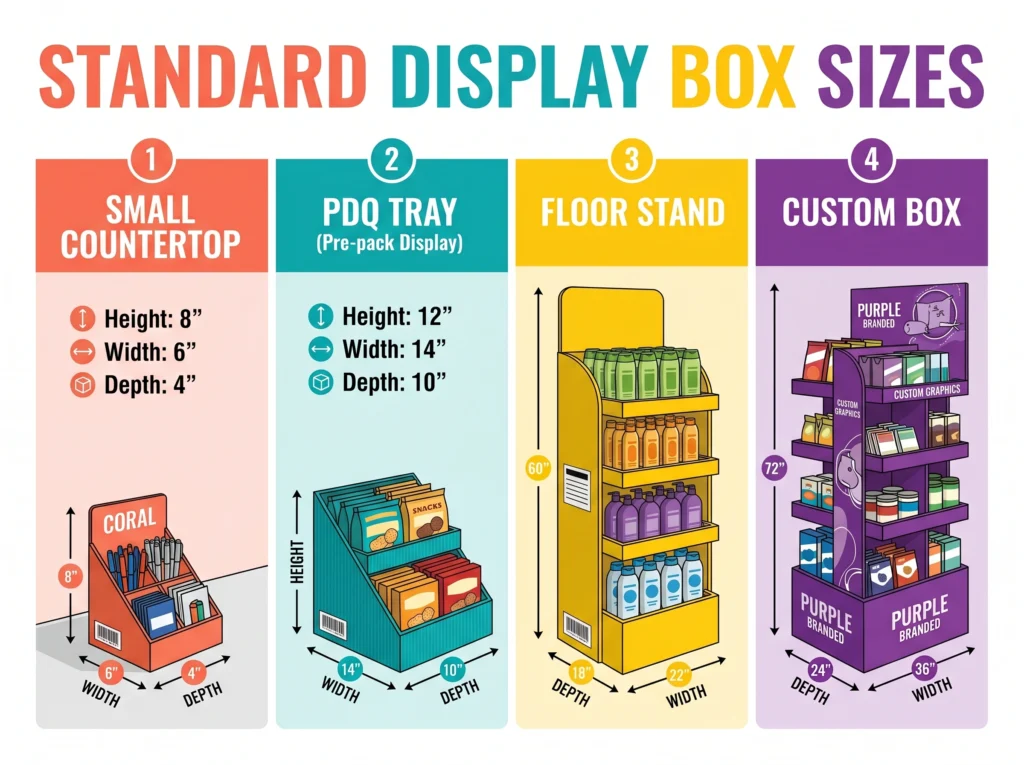
While custom display boxes can be made in almost any size, most fall into a few common categories. Use the chart below as a starting point. Remember, these are typical ranges, not strict rules, so your final size should always match your product.
| Display Box Type | Typical Use | Common Dimensions (L x W x H) | Best For |
| Countertop Display | Small items near checkout | 6″ x 4″ x 3″ to 9″ x 6″ x 4″ | Candy, balm, gum |
| PDQ Tray (Shelf-Ready) | Slides straight onto a shelf | 12″ x 9″ x 4″ to 15″ x 12″ x 5″ | Snacks, drinks |
| Floor Display | Stands on the store floor | 15″ x 15″ x 48″ to 24″ x 24″ x 60″ | Seasonal, bulk items |
| Small Product Display | Tiny retail goods | 4″ x 4″ x 2″ to 6″ x 6″ x 3″ | Jewelry, cosmetics |
| Custom Display Box | Built to your exact product | Any size you need | Unique products |
Tip: Always confirm the exact size with your packaging supplier before printing, since shelf space and product fit vary by store.
How to Measure Display Box Dimensions in 3 Easy Steps
Measuring is easier than it sounds. Grab a ruler or tape measure, your product, and follow these three steps.
Step 1: Measure Your Product First
Measure your product’s length, width, and height. If you plan to display several units, measure the full group as it will sit in the box (for example, three rows of four items).
Step 2: Add a Little Breathing Room
Add about 1/8 inch to 1/4 inch of extra space on each side. This small gap (called tolerance) lets products slide in and out without getting stuck or crushed.
Step 3: Write It as L x W x H
Put your numbers in the correct order: length, then width, then height. For example, a box written as 8″ x 5″ x 4″ is 8 inches long, 5 inches wide, and 4 inches tall.
Inner vs. Outer Dimensions: What Is the Difference?
Inner dimensions are the measurements inside the box, which decide what fits. Outer dimensions are the measurements outside the box, which affect shipping, shelf space, and storage.
The difference between them is the thickness of the cardboard. For sturdy display boxes, this can add 1/4 inch or more to each side. Always ask your supplier whether a quoted size refers to inner or outer dimensions so your product fits and your box ships correctly.
Also Read: Oyster Pail Box Packaging Dimensions: The Complete Size Guide
How Box Size Affects Shelves and Shipping Costs
Fitting Retail Shelves
Stores have set shelf heights and widths. A display box that is too tall or too wide may be turned away by a retailer. Before you order, check the shelf space where your box will live. Many shelves are around 12 to 15 inches deep, so a shelf-ready box should fit within that depth.
Saving on Shipping
Shipping carriers charge by dimensional weight (also called DIM weight), which is based on box size, not just actual weight. A bigger box can cost more to ship even if it is light. Keeping your dimensions tight, without crushing the product, helps lower shipping fees and reduces wasted space.
- Smaller boxes = lower DIM weight = cheaper shipping.
- Right-sized boxes = less filler material and less damage.
- Standard sizes = often cheaper than fully custom dies.
Common Display Box Sizing Mistakes to Avoid
- Forgetting tolerance, so the product gets stuck or crushed.
- Mixing up inner and outer dimensions when ordering.
- Ignoring retail shelf limits, leading to rejected displays.
- Writing measurements in the wrong order (always L x W x H).
- Choosing a box that is far bigger than the product, which wastes money and looks empty.
A trusted packaging partner like ONO Custom Boxes can review your product specs and recommend the right dimensions, so you avoid these slip-ups and get a display that looks great and ships smart.
Display box packaging dimensions are written as length x width x height (L x W x H)
Most countertop displays run from 6″ x 4″ x 3″ up to 9″ x 6″ x 4″, while shelf-ready PDQ trays are larger. To pick the right size, measure your product, add 1/8 to 1/4 inch of breathing room per side, and confirm whether the size is inner or outer before ordering.
Frequently Asked Questions (FAQ)
What are the standard display box packaging sizes?
Standard sizes range from small countertop boxes (about 6″ x 4″ x 3″) to large floor displays (up to 24″ x 24″ x 60″). The right size depends on your product and where it will be displayed.
How do I measure a display box correctly?
Measure your product’s length, width, and height, add a little space (1/8″ to 1/4″) on each side, and write the result as L x W x H.
What is the difference between inner and outer dimensions?
Inner dimensions decide what fits inside the box. Outer dimensions affect shipping and shelf space. The gap between them is the thickness of the board.
Why do display box dimensions affect shipping cost?
Carriers use dimensional (DIM) weight, which is based on box size. A larger box can cost more to ship, even when it is light, so right-sizing saves money.
Can I get a custom display box size?
Yes. Custom display boxes can be built to almost any size to match your exact product, branding, and shelf needs.
Final Thoughts
Choosing the right display box packaging dimensions does not have to be confusing. Start by measuring your product, add a little breathing room, double-check inner versus outer sizes, and keep retail shelves and shipping in mind. With these simple steps, you will land on a box that protects your product, looks sharp on the shelf, and keeps your costs in check. Happy packaging!