
Ever ordered custom boxes and watched your product rattle around inside like a marble in a shoebox? Or worse the box arrived too small, and your entire print run went to waste?
You’re not alone. Wrong box dimensions are the number one reason custom packaging orders fail. The good news? Measuring a box takes less than two minutes once you know the rules.
This guide shows you exactly how to measure a box length, width, and height the same way packaging pros do it. Grab a tape measure and let’s go.
Quick Answer (Read This First)
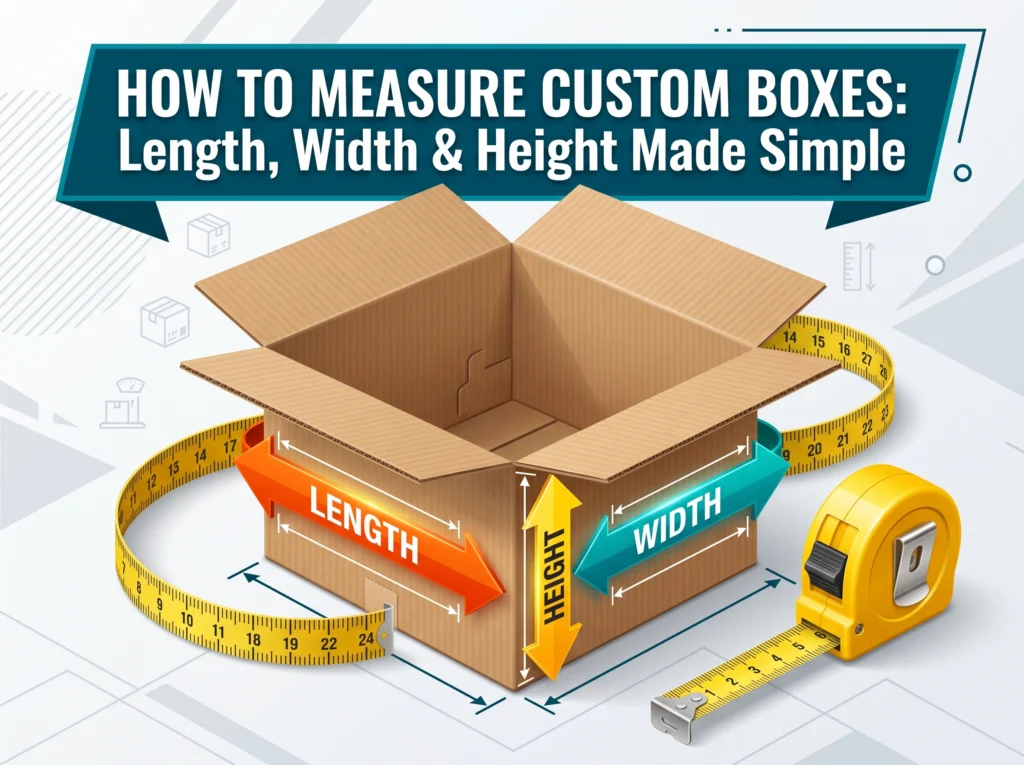
To measure a custom box, always use inside dimensions and list them in this order: Length × Width × Height (L × W × H).
- Length = the longest side of the box opening
- Width = the shorter side of the box opening
- Height = the distance from the opening down to the base
So a box listed as 12″ × 9″ × 4″ is 12 inches long, 9 inches wide, and 4 inches tall measured on the inside.
That’s it. Everything below explains the details that keep you from making expensive mistakes.
Why Box Measurements Trip People Up
Here’s the tricky part most people miss: box makers use inside dimensions, but most buyers measure the outside.
Why does this matter? Because corrugated cardboard has thickness. A B-flute box wall is about 1/8 inch thick. Measure the outside, and your interior measurements shrink by up to a quarter inch on every side. That’s enough to crush a candle jar or crack a phone case.
Rule to remember: Your product lives inside the box. So measure the inside.
Step-by-Step: How to Measure a Box the Right Way
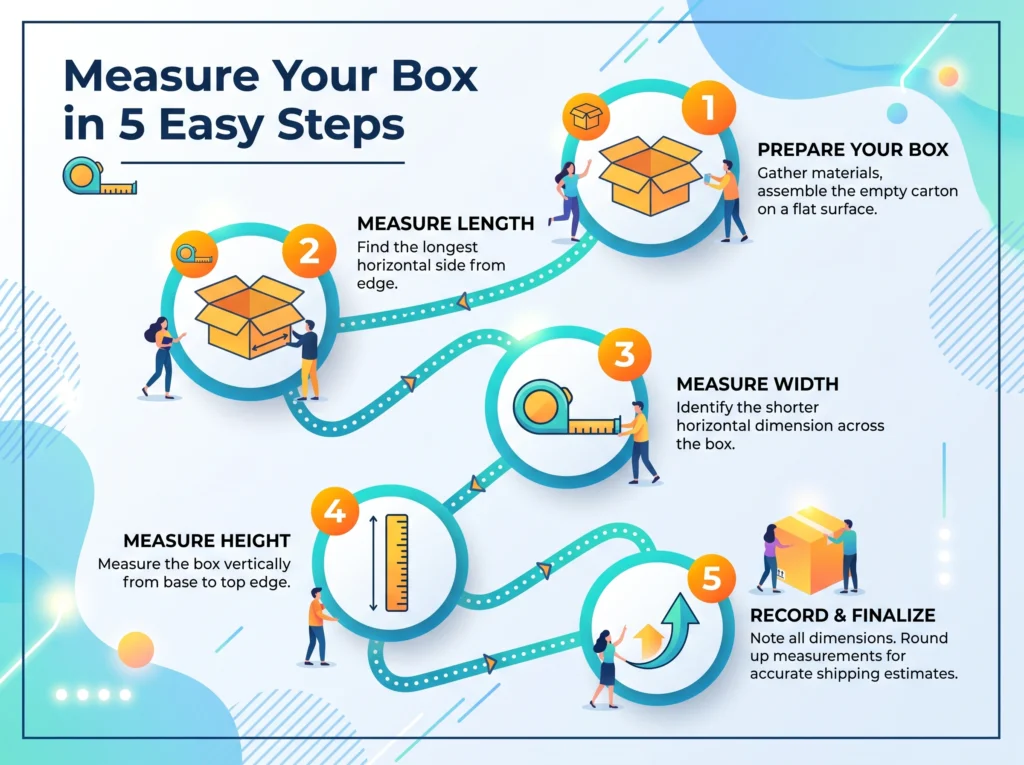
Step 1: Find the Opening
Place the box so the opening faces up. On a standard shipping box (called an RSC or Regular Slotted Container), the opening is where the flaps meet.
Step 2: Measure the Length
Run your tape measure across the longest side of the opening, from inside wall to inside wall. Write it down first length always comes first in L × W × H.
Step 3: Measure the Width
Now measure the shorter side of the opening, again inside wall to inside wall. This is your width.
Step 4: Measure the Height (or Depth)
Measure from the top of the opening straight down to the inside base. Some suppliers call this depth height and depth mean the same thing in packaging. You may see L × W × D instead of L × W × H. Don’t panic it’s the same measurement.
Step 5: Round Up, Never Down
If your measurement lands between marks, round up to the nearest 1/16 inch. A slightly roomy box works. A slightly tight box doesn’t.
Also Read: How to Measure Shoe Box Packaging Dimensions (The Right Way )
Inside vs. Outside Dimensions
| Feature | Inside Dimensions | Outside Dimensions |
|---|---|---|
| Used by | Box manufacturers & custom packaging quotes | Shipping carriers (USPS, UPS, FedEx) |
| Purpose | Making sure your product fits | Calculating dimensional weight & postage |
| How to measure | Wall to wall, inside the box | Edge to edge, outside the box |
| Difference | Smaller by the wall thickness (about 1/8″–1/4″) | Larger by the wall thickness |
| When to use | Ordering custom boxes | Booking shipping labels |
Bottom line: Order with inside dimensions. Ship with outside dimensions.
How to Measure Different Box Styles
Not every box is a plain shipping cube. Here’s how measuring changes by style:
| Box Style | Where the Opening Is | Measuring Tip |
|---|---|---|
| RSC shipping box | Top flaps | Standard L × W × H from the opening |
| Mailer box | Front lid folds open | Measure with the lid closed height is the shallow side |
| Tuck-end box | Small end flap | Length runs along the longest panel, not the opening |
| Rigid box with lid | Removable top | Measure the base only, inside walls |
| Folding carton | Top tuck | Measure assembled, never flat |
How Much Room Should You Leave? (Clearance Guide)
Your product needs a little breathing room packaging pros call this tolerance or clearance. Too tight and the box bulges. Too loose and your product bounces during shipping.
| Product Type | Recommended Clearance (each side) |
|---|---|
| Rigid items (books, boxes, tins) | 1/16″ – 1/8″ |
| Fragile items with void fill or inserts | 1/4″ – 1/2″ |
| Soft goods (apparel, textiles) | 1/8″ – 1/4″ |
| Electronics with foam inserts | 1/2″ or per insert spec |
Pro tip: Measure your product first, add clearance, and that total becomes your box’s inside dimension. Companies like ONO Custom Boxes build to your inside dimensions, so this number is the one that goes on your order form.
Don’t Forget Dimensional Weight (The Hidden Shipping Cost)
Carriers like UPS, FedEx, and USPS don’t just weigh your package they measure it. This is called dimensional weight (or DIM weight), and it can raise your shipping cost if your box is bigger than it needs to be.
The formula:
DIM Weight = (Length × Width × Height in inches) ÷ Carrier Divisor
Most carriers use a divisor of 139 for domestic shipments. Example: a 12 × 9 × 4 box = 432 cubic inches ÷ 139 = about 3.1 lbs billable weight even if the contents weigh only 1 lb.
Right-sizing your packaging matching the box closely to the product cuts DIM charges, reduces void fill, and supports sustainable packaging goals. Smaller boxes also improve the unboxing experience because products arrive snug and secure.
5 Costly Measuring Mistakes to Avoid
- Measuring the outside instead of the inside. The classic. It shrinks your usable space by the wall thickness.
- Mixing up length and width. Length is always the longer side of the opening.
- Forgetting units. Ordering from an overseas supplier? Confirm inches vs. centimeters before you pay. (1 inch = 2.54 cm.)
- Measuring a flat, unassembled box. Flat dieline measurements are not box dimensions. Always assemble first.
- Skipping clearance. A box that matches your product exactly is a box that’s too small.
Frequently Asked Questions
What order do box dimensions go in?
Always Length × Width × Height (L × W × H). Length is the longest side of the opening, width is the shorter side, and height runs from the opening to the base.
Do you measure a box from the inside or outside?
Measure the inside when ordering custom packaging that’s what manufacturers use. Measure the outside only when calculating shipping costs.
Is depth the same as height?
Yes. Depth (D) and height (H) mean the same thing in packaging. L × W × D and L × W × H are identical formats.
What does 12x9x4 mean on a box?
It means the box is 12 inches long, 9 inches wide, and 4 inches high, measured inside. The first number is always length.
How much bigger should a box be than my product?
Add 1/8 inch to 1/2 inch of clearance per side, depending on how fragile the item is and whether you’re using inserts or padding.
How do I measure a mailer box?
Close the lid first, then measure inside: length across the long opening edge, width across the short edge, and height from lid to base. Ignore the flaps.
How do I measure a box for Amazon FBA?
Use outside dimensions for Amazon FBA size tiers, and round to the nearest tenth of an inch. Amazon re-measures packages, so accuracy protects you from fee surprises.
Why is my custom box quote based on inside dimensions?
Because the manufacturer’s job is to fit your product, and your product sits inside the box. Inside dimensions remove the guesswork caused by different wall thicknesses and flute types.
Final Takeaway
Measuring a custom box comes down to three simple rules: measure inside, list Length × Width × Height, and add a little clearance. Do those three things and your next packaging order will fit right the first time no reprints, no wasted budget, no product rattling around in transit.
Now grab that tape measure. Your perfect-fit box is three numbers away.