
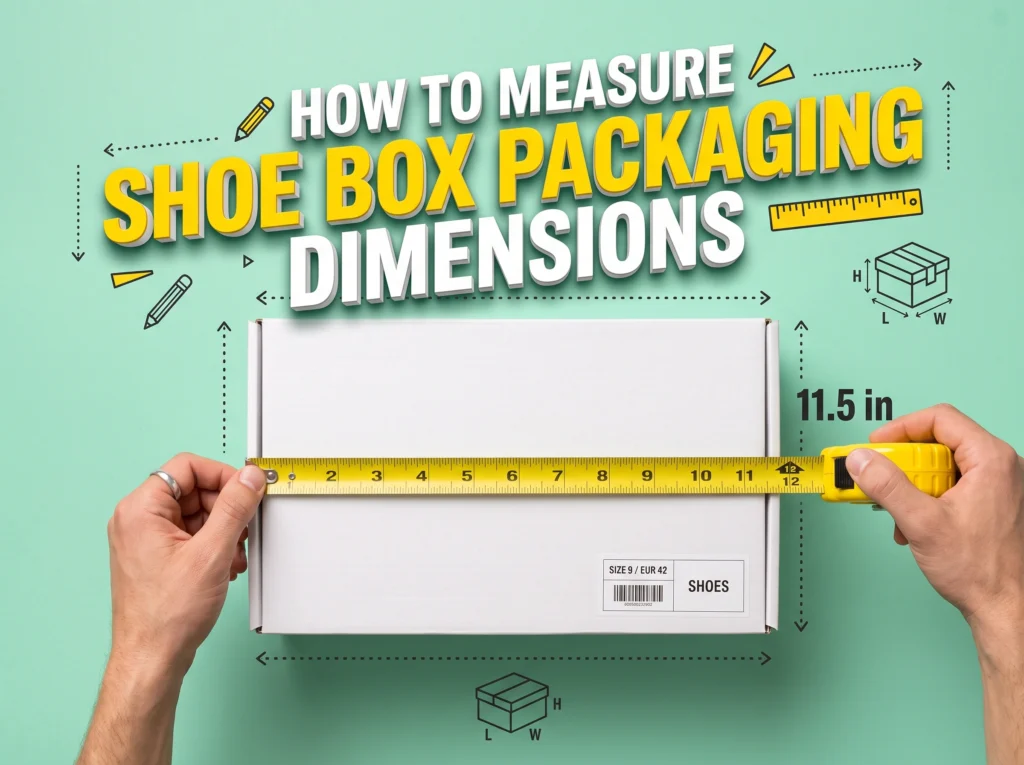
Did you know that measuring a box wrong can double your shipping bill?
It happens every single day. A seller lists a pair of sneakers, guesses the box size, and then USPS, UPS, or FedEx charges extra because of something called dimensional weight. Ouch.
The good news? Measuring a shoe box the right way takes less than 60 seconds once you know the simple rules. This guide shows you exactly how to do it, whether you ship on eBay, sell on Amazon FBA, flip sneakers on StockX or GOAT, or order custom shoe boxes from a manufacturer.
Let’s make it easy.
What You Need Before You Start
Grab these three things:
- A tape measure or ruler (a soft measuring tape works too)
- Your shoe box with the lid closed
- A notepad or your phone to write down the numbers
That’s it. No fancy tools needed.
The 3 Numbers That Matter: Length, Width, and Height
Every box in the world is measured the same way: Length × Width × Height (written as L×W×H).
Here’s how to tell them apart:
- Length = the longest side of the box
- Width = the shorter side, measured left to right
- Height = how tall the box stands, bottom to top
Quick tip: Always list length first. Carriers, marketplaces, and packaging suppliers all expect L×W×H in that exact order.
How to Measure a Shoe Box in 3 Simple Steps
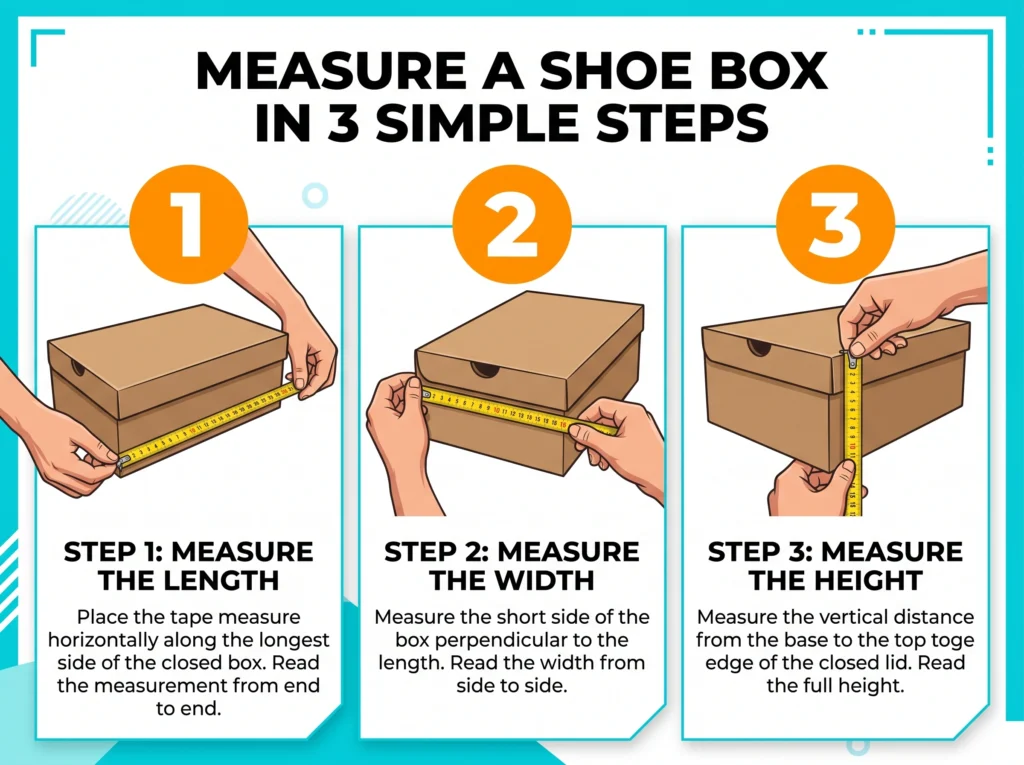
Step 1: Close the Lid and Measure the Length
Place the box on a flat table. Stretch your tape measure along the longest side. Write down the number in inches (or centimeters if your supplier uses metric).
Step 2: Measure the Width
Now measure the shorter side, from one edge to the other. This is your width.
Step 3: Measure the Height with the Lid ON
Measure from the table up to the top of the closed lid. Carriers always measure with the lid closed, so you should too.
One golden rule: Carriers round UP to the nearest inch. A box that measures 13.2 inches counts as 14 inches. Round up yourself so there are no surprise fees.
Inside Dimensions vs. Outside Dimensions (This Trips Everyone Up)
Here’s the part most people miss and it matters a lot.
- Outside dimensions (external dims): What shipping carriers use to charge you. Measure the outer edges of the box.
- Inside dimensions (internal dims): What packaging manufacturers use when you order custom printed boxes. This is the space your shoes actually sit in.
So if you’re shipping, measure the outside. If you’re ordering custom shoe box packaging from a supplier like Uline, Packlane, or an Alibaba manufacturer, they will quote you inside dimensions and often in millimeters.
Pro tip for custom orders: Measure your shoe first, then add about 0.5 inches (roughly 1.5 cm) of clearance on every side. This gives the shoes room to slide in without crushing the corrugated box or rigid box walls.
Standard Shoe Box Dimensions Chart
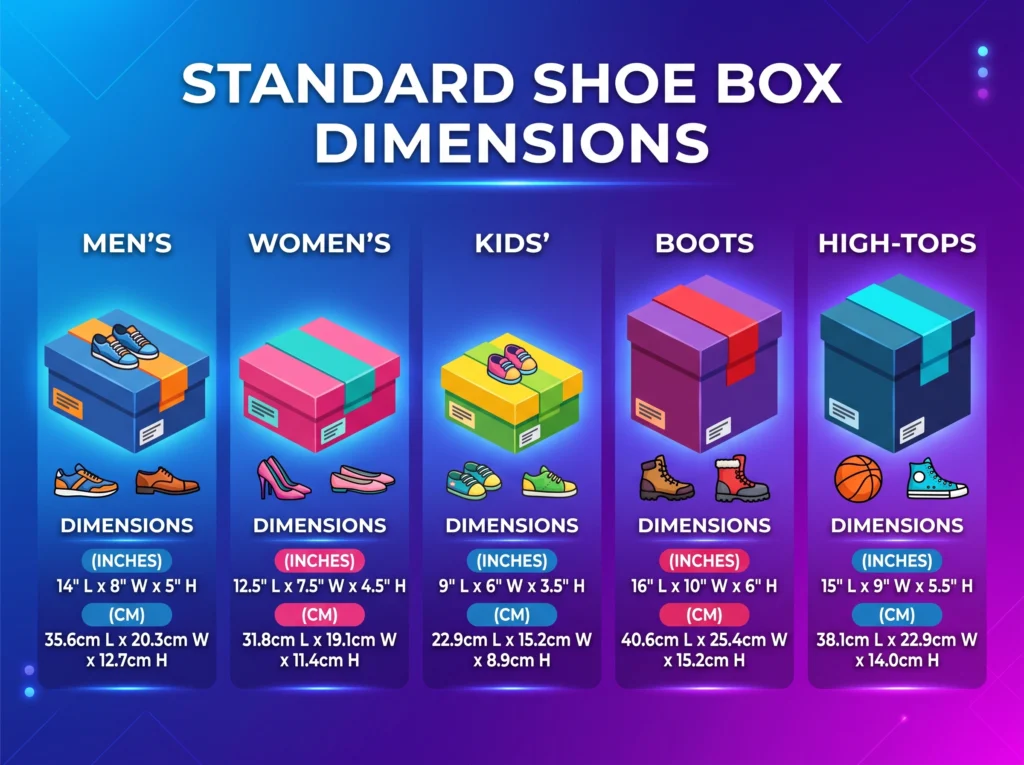
No two brands use the exact same box, but these are the most common shoe box sizes you’ll see:
| Shoe Type | Length (in) | Width (in) | Height (in) | Length (cm) | Width (cm) | Height (cm) |
|---|---|---|---|---|---|---|
| Men’s sneakers | 14 | 8 | 5 | 35.5 | 20 | 13 |
| Women’s shoes | 13 | 7.5 | 4.5 | 33 | 19 | 11.5 |
| Kids’ shoes | 11 | 6.5 | 4 | 28 | 16.5 | 10 |
| Boots | 15–17 | 10–12 | 5–7 | 38–43 | 25–30 | 13–18 |
| High-tops / Jordan style | 14.5 | 9 | 5.5 | 37 | 23 | 14 |
Note: Nike shoe box dimensions typically run about 14 × 8 × 5 inches for adult sneakers, while Adidas, New Balance, Vans, and Converse boxes are close but slightly different. Always measure your exact box never guess from a chart alone.
How to Calculate Dimensional Weight (Stop Overpaying to Ship Shoes)
Dimensional weight (also called DIM weight or billable weight) is how carriers charge for big-but-light packages. Here’s the simple formula:
Length × Width × Height ÷ DIM divisor = Dimensional Weight
Most major carriers use a divisor of 139 for cubic inches.
Example: A 14 × 8 × 5 inch shoe box: 14 × 8 × 5 = 560 cubic inches 560 ÷ 139 = about 4 lbs of billable weight
If your shoes weigh 2 lbs but the DIM weight is 4 lbs, you pay for 4 lbs. That’s why smaller, right-sized packaging saves real money and why carriers now reward it with lower rates.
Shipping a Shoe Box: Smart Money-Saving Tips
- Does a shoe box fit in a USPS flat rate box? Most men’s shoe boxes are too long for the Medium Flat Rate Box (13⅝ inches inside). Women’s and kids’ boxes often fit. Measure first!
- Poly mailer vs. box: Wrapping a shoe box in a poly mailer can shrink your package dimensions slightly and dodge oversize surcharges.
- Watch the 2026 rate changes: USPS and UPS update dimensional pricing rules regularly, so recheck rates each season.
- Amazon sellers: Learn frustration-free packaging and ships-in-own-container (SIOC) rules right-sized boxes get better treatment in FBA.
Ordering Custom Shoe Box Packaging? Measure Like a Pro
If you run a shoe brand or a Shopify or Etsy store, your unboxing experience starts with the right box specs. When you request a quote:
- Give inside dimensions in the order L×W×H
- State your unit clearly inches or millimeters (overseas suppliers default to metric)
- Choose your box style: lid and base box, tuck box, or mailer box
- Ask about board thickness and flute type for strength
- Confirm the tolerance (most makers allow ±2–3 mm)
Trusted suppliers such as ONO Custom Boxes will walk you through kraft box options, die-cut designs, and eco-friendly shoe packaging a smart choice since sustainable shoe packaging is one of the biggest buyer trends right now.
Common Mistakes to Avoid
- Measuring with the lid off (always measure closed)
- Mixing up inside and outside dims when ordering
- Forgetting to round up to the nearest inch
- Ignoring girth limits on large boot boxes
- Skipping unit conversion 35 cm is NOT 35 inches!
- Guessing from a size chart instead of measuring your actual box
FAQs
What are the dimensions of a standard shoe box?
A standard men’s shoe box measures about 14 × 8 × 5 inches (35.5 × 20 × 13 cm). Women’s boxes are slightly smaller at around 13 × 7.5 × 4.5 inches.
Do you measure a box length, width, or height first?
Always start with length (the longest side), then width, then height. The universal order is L×W×H.
Do you measure a shoe box inside or outside?
For shipping, measure the outside dimensions. For custom packaging orders, suppliers use inside dimensions.
How do I calculate dimensional weight for a shoe box?
Multiply Length × Width × Height in inches, then divide by 139. Round up to the next whole pound. That’s your billable weight.
What size box do I need to ship shoes?
Match the box to your shoe box’s outside dimensions, adding about half an inch of padding room on each side. Or slide the original box into a snug shipping box or poly mailer.
Do carriers measure with the lid closed?
Yes. Carriers scan the full parcel size with everything sealed, including any bulge or overhang.
How much clearance should a custom shoe box have?
Add roughly 0.5 inches (1.5 cm) around the shoe on all sides so the pair slides in comfortably without damage.
Key Takeaways
- Measure L×W×H with the lid closed, and round up to the nearest inch
- Outside dims = shipping. Inside dims = custom packaging orders
- Use the DIM weight formula (L×W×H ÷ 139) to predict your true shipping cost
- Add 0.5 inches of clearance when ordering custom shoe boxes
- Always measure your real box brand sizes vary
Measure once the right way, and you’ll ship faster, spend less, and order packaging with total confidence. Grab that tape measure you’ve got this!