
Picking the right box for your vials sounds simple. Then you hold a tiny glass vial in one hand, an oversized carton in the other, and wonder why they do not match. Good news: getting vial box packaging dimensions right is easy once you know what to measure and which standard sizes exist.
This guide walks you through standard sizes, how to measure, insert options, and the small details that protect your product during shipping. By the end, you will be able to choose or order the perfect box with confidence.
What “Vial Box Packaging Dimensions” Really Means
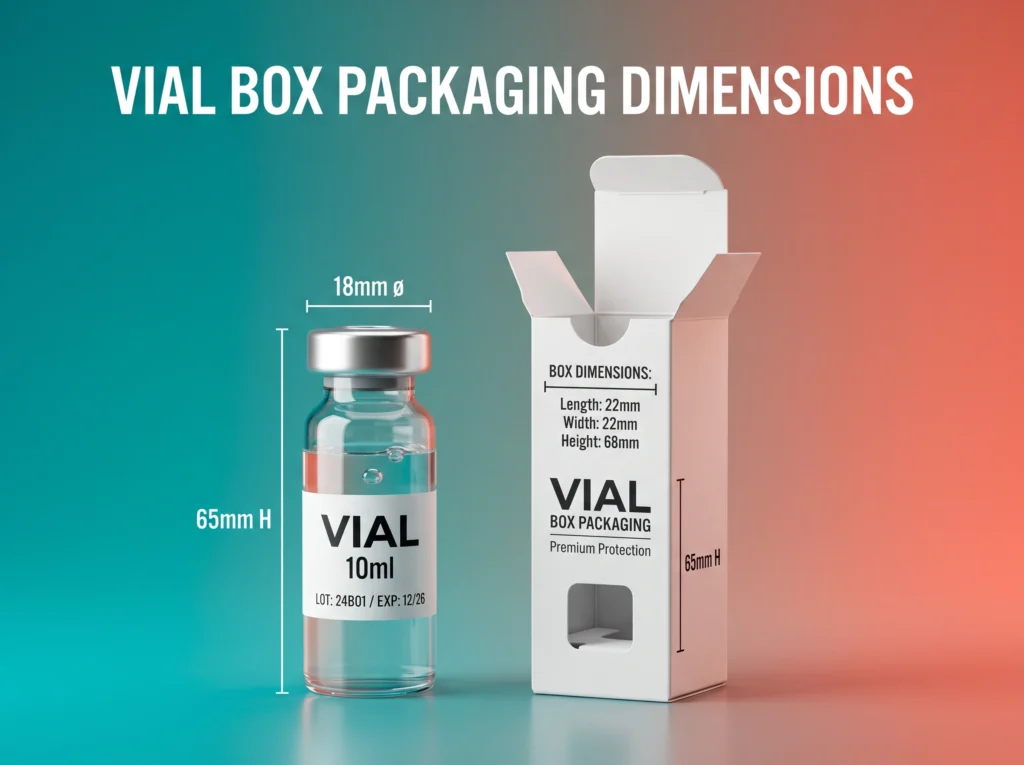
A vial box (also called a vial carton) is the secondary packaging that holds and protects your vial. The vial itself is the primary packaging. Dimensions describe the box in three numbers: length × width × height (L × W × H), usually in millimeters (mm) or inches.
Here is the key point many people miss: vial size is measured in fill volume (mL), but box size is measured in physical space (mm). A 10 mL vial does not equal a 10 mm box. You match the box to the vial’s real height and diameter, plus room for an insert tray and a leaflet.
Standard Vial Box Size Chart
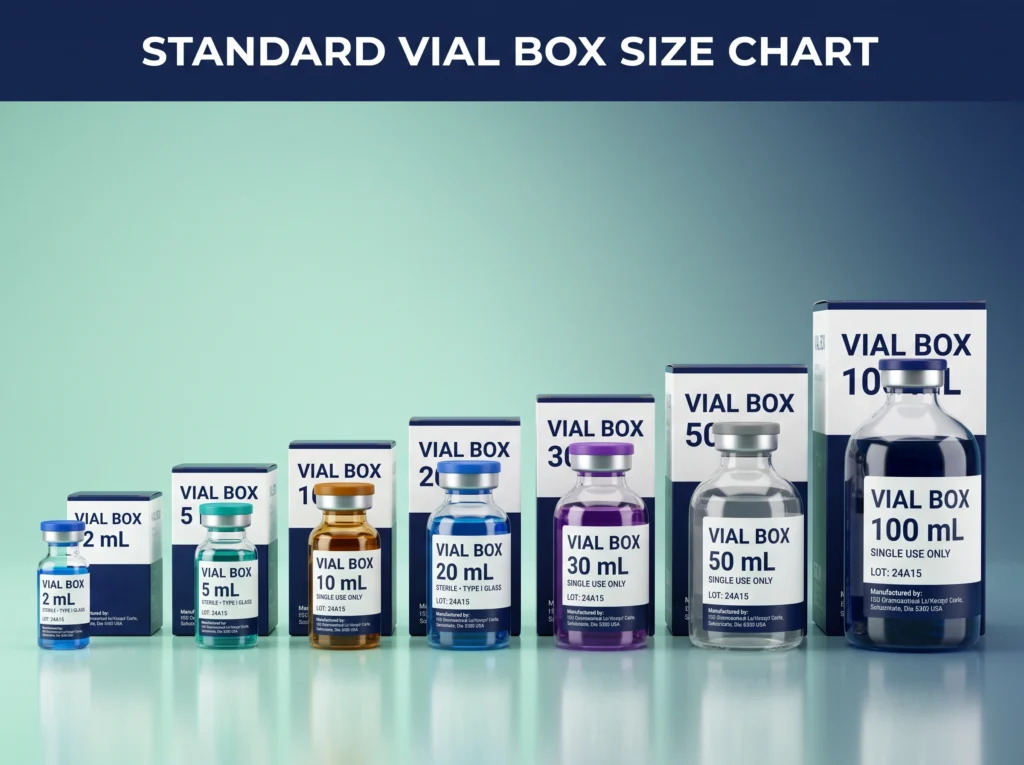
Below is a handy reference that maps common vial volumes to typical single-vial box dimensions. Use it as a starting point, then fine-tune for your exact vial and any inserts.
| Vial Volume | Typical Vial Diameter | Typical Vial Height | Suggested Box Inner Dimensions (L × W × H) |
|---|---|---|---|
| 2 mL | 16 mm | 35 mm | 22 × 22 × 42 mm |
| 5 mL | 22 mm | 40 mm | 28 × 28 × 48 mm |
| 10 mL | 24 mm | 45 mm | 30 × 30 × 52 mm |
| 20 mL | 30 mm | 55 mm | 36 × 36 × 62 mm |
| 30 mL | 33 mm | 65 mm | 40 × 40 × 72 mm |
| 50 mL | 40 mm | 73 mm | 47 × 47 × 82 mm |
| 100 mL | 47 mm | 95 mm | 54 × 54 × 105 mm |
These are common reference sizes. Always confirm against your supplier’s exact vial specs, since neck finish and crimp cap height vary by brand.
Multi-Vial Box Dimensions (5-Pack and 10-Pack)
Many brands ship vials in sets. When you package several vials, you add a foam partition or insert tray so they do not touch and break. Here is a quick guide for multi-vial layouts using 10 mL vials as the example.
| Pack Size | Layout | Suggested Box Inner Dimensions (L × W × H) |
|---|---|---|
| 5 vials | 5 × 1 row | 160 × 32 × 52 mm |
| 10 vials | 5 × 2 rows | 160 × 62 × 52 mm |
| 25 vials | 5 × 5 grid | 160 × 160 × 52 mm |
Add 3–5 mm of clearance on each side for the partition walls. This keeps each vial snug and removes the rattle that leads to cracked glass.
How to Measure a Vial for Custom Packaging
You only need a ruler or caliper and a minute of your time. Follow these steps:
- Measure vial diameter. Place the caliper across the widest part of the body. Note this in mm.
- Measure vial height. Include the crimp cap or closure, since that is the true height.
- Count your vials and choose a layout. One vial, a 5-pack, or a 10-pack each need a different footprint.
- Add insert space. Allow 2–4 mm per side for a snug insert tray or foam partition.
- Add leaflet room if needed. A folded leaflet or instruction slip adds a few mm of height or width.
- Confirm your unit. Decide on mm or inches and keep it consistent on your order form.
With these numbers, you can request an exact custom size with no guesswork.
Also Read: Nail Box Packaging Dimensions: The Complete Size Guide
Choosing the Right Box Style
Different products call for different box styles. Here is a clear comparison to help you decide.
| Box Style | Best For | Strength | Notes |
|---|---|---|---|
| Folding carton (paperboard) | Pharma, cosmetics, retail | Light, low cost, print-friendly | Most common; great for leaflet space |
| Rigid box | Premium serums, gift sets | Very sturdy, luxury feel | Higher cost, fixed size |
| Corrugated mailer | Shipping, multi-vial kits | Strong, protective | Ideal for cold chain and e-commerce |
| Tube box | Single vial, slim look | Compact, modern | Limited print area |
Material thickness matters too. Paperboard is measured in GSM or caliper, while corrugated is rated by flute. For most single vials, a sturdy paperboard around 350 GSM holds shape and prints cleanly.
Inserts and Partitions: The Secret to Safe Vials
A box alone will not stop a vial from sliding around. The insert is what keeps your product still and safe. Common choices include molded foam, paperboard partitions, and blister trays.
The right insert removes empty space, cancels the rattle, and lowers your return rate from breakage. When you order, share your exact vial diameter and height so the insert cradles each vial perfectly.
Shipping, Cold Chain, and Compliance Notes
If your vials travel far or need to stay cool, a few extra dimensions come into play. Cold chain mailers add insulation and a gel pack, so your inner box must leave room for both. Test your final pack against ISTA shipping standards to be sure it survives the journey.
For regulated products, leave space on the carton for a label, batch code, and serialization data where DSCSA rules apply. Pharma teams often follow GMP and USP guidance, and child-safe products may need child-resistant certified cartons. Always check current FDA requirements for your category, since rules update over time.
Trending in Vial Packaging Right Now
The market is moving fast, and these trends shape how brands size and source their boxes:
- Sustainable vial packaging made from recyclable mono-material paperboard
- Eco-friendly cartons that skip plastic laminates
- Serialization-ready cartons with clean print zones for QR codes
- Smart packaging using QR or NFC tags for authenticity
- Demand for peptide and GLP-1 vial boxes with secure multi-vial inserts
- Anti-counterfeit packaging with tamper-evident seals
Designing with these trends in mind keeps your packaging modern and shelf-ready.
Common Pain Points (and Easy Fixes)
- “My box is too big and the vial rattles.” Add an insert tray or foam partition sized to your exact vial.
- “I confused mL with mm.” Remember: mL is fill volume; mm is physical size. Measure the real vial body.
- “Vials keep breaking in transit.” Remove void space and test against ISTA standards.
- “I do not know the minimum order.” Ask your supplier about MOQ early so sizing and budget line up.
- “No room for my leaflet.” Add a few mm of height or width before you finalize the size.
Frequently Asked Questions
What are the standard dimensions of a vial box?
Single-vial boxes commonly range from about 22 × 22 × 42 mm for a 2 mL vial up to 54 × 54 × 105 mm for a 100 mL vial. Match the box to your vial’s true diameter and height plus insert space.
What size box fits a 10 mL vial?
A common inner size is around 30 × 30 × 52 mm, which gives a typical 10 mL vial room for a snug insert.
How do I measure a vial for custom packaging?
Measure the widest diameter and the full height including the cap, then add 2–4 mm per side for the insert and a little extra for a leaflet.
What is the difference between a vial box and a vial carton?
They are the same thing. Both terms describe the secondary packaging that holds the vial.
How many vials fit in a standard box?
It depends on your layout. A 5 × 2 grid holds 10 vials, while a 5 × 5 grid holds 25. Add partition clearance for each row.
What material is best for vial boxes?
Paperboard folding cartons around 350 GSM work for most single vials. Use corrugated for shipping and heavier multi-vial kits.
Are there FDA rules for vial carton dimensions?
The FDA does not set one fixed size, but it does require clear labeling, batch info, and serialization space for many pharma products. Always check current rules for your category.
What is the minimum order for custom vial boxes?
MOQs vary by supplier and box style. Confirm this early so your dimensions and budget align.
Quick-Reference Takeaways
- Vial size is mL; box size is mm. Measure the real vial body, not the volume.
- Add 2–4 mm per side for an insert tray or foam partition.
- Use a folding carton for retail, corrugated for shipping, rigid for premium.
- Leave room for a leaflet, label, and serialization data where required.
- Test your final pack against ISTA standards before a big run.
Need exact sizing help? A specialist team like ONO Custom Boxes can match your vial specs to the perfect box and insert, so every shipment arrives safe and looking sharp.