
Picking the right box size sounds simple, but it can make or break how your products ship, stack, and arrive. If you have ever opened a carton that was half empty or watched a package get crushed in transit, you already know why half box dimensions matter so much.
This guide breaks down everything in plain language. You will learn standard half box packaging sizes, the difference between internal and external measurements, how much a half box can hold, and how to pick the perfect fit for your products. Let’s dive in.
What Is a Half Box?
A half box is a shorter version of a standard shipping carton. The most common type is the Half Slotted Carton (HSC), which looks like a Regular Slotted Container (RSC) but with only one set of flaps. The top stays open, so it works great for items you slide in from above.
People use half boxes for produce, retail display, e-commerce orders, and subscription boxes. Because they use less material, they can lower cost and cut waste, which is a big win for sustainable packaging goals.
The word “half” can mean different things across industries, so always check the spec sheet before you order. A half produce box is not the same as a half retail display box.
Standard Half Box Packaging Dimensions
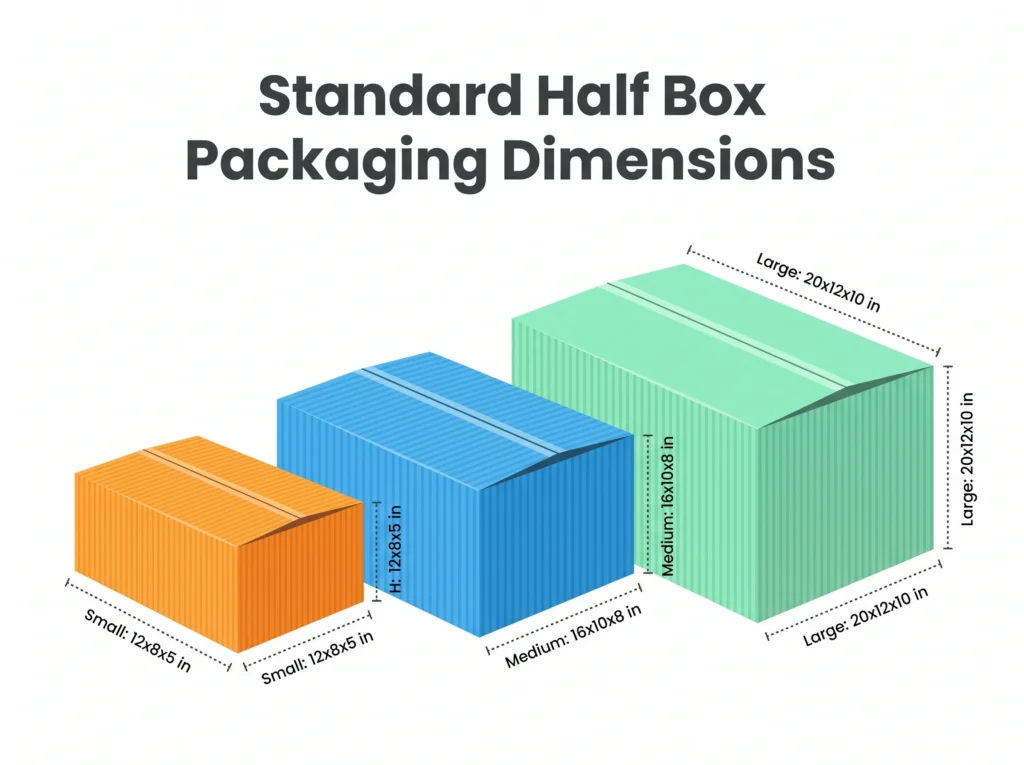
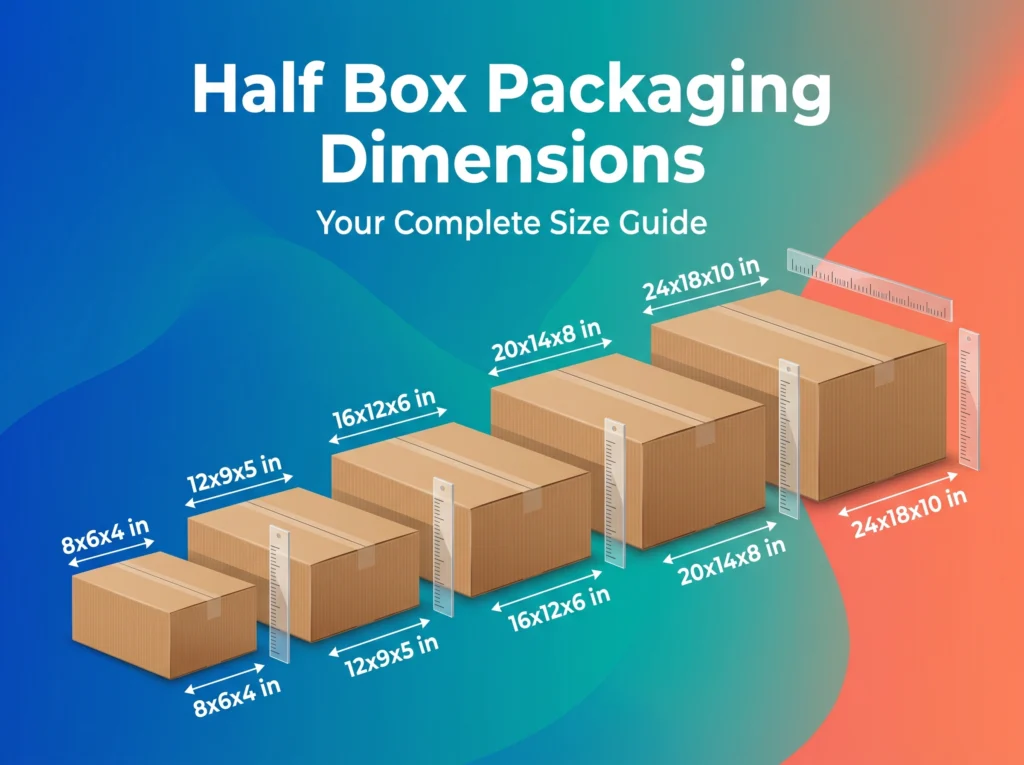
There is no single universal standard, but most suppliers follow a common range. Here are typical half box measurements you will see, listed by both inches and centimeters.
| Box Size | External (L × W × H, inches) | External (cm) | Best For |
|---|---|---|---|
| Small Half Box | 12 × 9 × 4 | 30 × 23 × 10 | Books, small goods |
| Medium Half Box | 16 × 12 × 6 | 41 × 30 × 15 | Apparel, kits |
| Large Half Box | 20 × 15 × 8 | 51 × 38 × 20 | Bulk retail, produce |
| Half Produce Box | 16 × 13 × 6 | 41 × 33 × 15 | Fruits, vegetables |
These are external dimensions. Your actual product space, the internal dimensions, will be slightly smaller because of board thickness. Always order by the measurement that matches your need.
Internal vs External Dimensions: Why It Matters
This is the number one mix-up buyers make, so let’s clear it up.
- Internal dimensions are the usable space inside the box. Order by these when your product must fit snugly.
- External dimensions are the outside footprint. Order by these when shipping cost, DIM weight, or pallet fit is your concern.
The gap between the two depends on the flute type and whether you use single-wall or double-wall board. A thicker corrugated fiberboard wall protects more but eats into inside space. For most light items, single-wall B-flute or C-flute does the job.
How Much Can a Half Box Hold?
Box capacity depends on three things: size, material strength, and how you stack it. Two numbers guide you here.
First is load capacity, the weight the box can carry. This ties directly to the ECT rating (Edge Crush Test) or burst strength of the board. A standard single-wall half box often handles 20 to 65 pounds safely.
Second is cubic volume, the space inside. A medium half box at 16 × 12 × 6 inches gives you roughly 1,152 cubic inches of room. Knowing your cubic volume helps you avoid empty space, which saves money on filler and shipping.
Also Read: Custom Labels Packaging Dimensions: The Simple Guide to Getting the Perfect Fit
Half Box vs Full Box
| Feature | Half Box (HSC) | Full Box (RSC) |
|---|---|---|
| Flaps | One set (open top) | Two sets (closed) |
| Height | Shorter | Taller |
| Material used | Less | More |
| Best use | Display, top-load items | Full enclosure, shipping |
| Cost | Lower | Higher |
Choose a half box when you want easy top access, lower cost, and a cleaner display. Pick a full box when you need complete protection on all sides.
How Many Half Boxes Fit on a Pallet?
Smart pallet planning lowers freight cost and protects your goods. A standard GMA pallet measures 48 × 40 inches. The number of half boxes per layer depends on your box footprint.
For a medium half box (16 × 12 inches), you can fit about 10 boxes per layer with minimal wasted space. Stack height then depends on your load capacity and warehouse rules. Following ISTA standards for stacking helps your shipments pass transit tests with ease.
How to Choose the Right Half Box Size
Follow these simple steps to land on the perfect fit:
- Measure your product. Note length, width, and height, then add a little room for protective fill.
- Pick internal or external priority. Snug fit means order by internal; shipping savings means watch external.
- Match the material. Light goods need single-wall; heavy items need double-wall or a higher ECT rating.
- Plan the pallet. Confirm your box footprint divides cleanly into a GMA pallet layout.
- Test before bulk ordering. Request a sample so you can check fit and strength firsthand.
A trusted maker like ONO Custom Boxes can help you spec a custom half box that fits your product and your budget.
Why the Right Dimensions Boost Your Bottom Line
Right-sizing your packaging is one of the easiest wins in shipping. Tight, well-fitted boxes mean less filler, lower DIM weight charges, and fewer damaged returns. They also support eco-friendly corrugated boxes and plastic-free packaging goals that today’s shoppers love.
Brands moving toward retail-ready packaging (RRP) and recyclable kraft boxes often find that a smart half box does double duty: it ships safely and displays beautifully on the shelf. That is packaging optimization at its best.
Also Read: Soap Box Packaging Dimensions: The Complete Sizing Guide
Common User Pain Points (Solved)
- “Half box” means different things. Always confirm the type, HSC, produce, or display, before you order.
- No universal standard exists. Use a supplier spec sheet and request samples to be sure.
- Internal vs external confusion. Decide which matters most for your goal, then order by that number.
- Unclear weight limits. Check the ECT rating or burst strength printed on the box certificate.
- Pallet waste. Match your box footprint to a GMA pallet for a clean fit.
Frequently Asked Questions
What are the standard dimensions of a half box?
Common sizes range from 12 × 9 × 4 inches for small boxes up to 20 × 15 × 8 inches for large ones. There is no single global standard, so always check the supplier spec.
What is the difference between a half box and a full box?
A half box, often a Half Slotted Carton, has one set of flaps and an open top. A full box, like a Regular Slotted Container, has two sets of flaps and fully closes.
How much weight can a half box hold?
A standard single-wall half box usually carries 20 to 65 pounds, based on its ECT rating and burst strength. Double-wall boards hold more.
Should I order by internal or external dimensions?
Order by internal dimensions when product fit matters most. Order by external dimensions when shipping cost, DIM weight, or pallet fit is your priority.
Are half box and half slotted carton the same thing?
Often yes. The Half Slotted Carton (HSC) is the most common style of half box, though some industries use the term for other short cartons too.
Can half box dimensions be customized?
Yes. Custom makers can build a box to your exact size, material, and print needs, which helps with both fit and branding.
How many half boxes fit on a pallet?
It depends on the box footprint. A medium half box (16 × 12 inches) fits about 10 per layer on a standard 48 × 40 inch GMA pallet.
Final Thoughts
Getting your half box packaging dimensions right is a small step that pays off big. You save on shipping, cut waste, protect your products, and give customers a great unboxing. Start by measuring your product, decide whether internal or external sizing matters most, match the right material, and always test a sample before you buy in bulk.
With the size charts and tips above, you are ready to choose a half box that fits your products and your goals perfectly.