
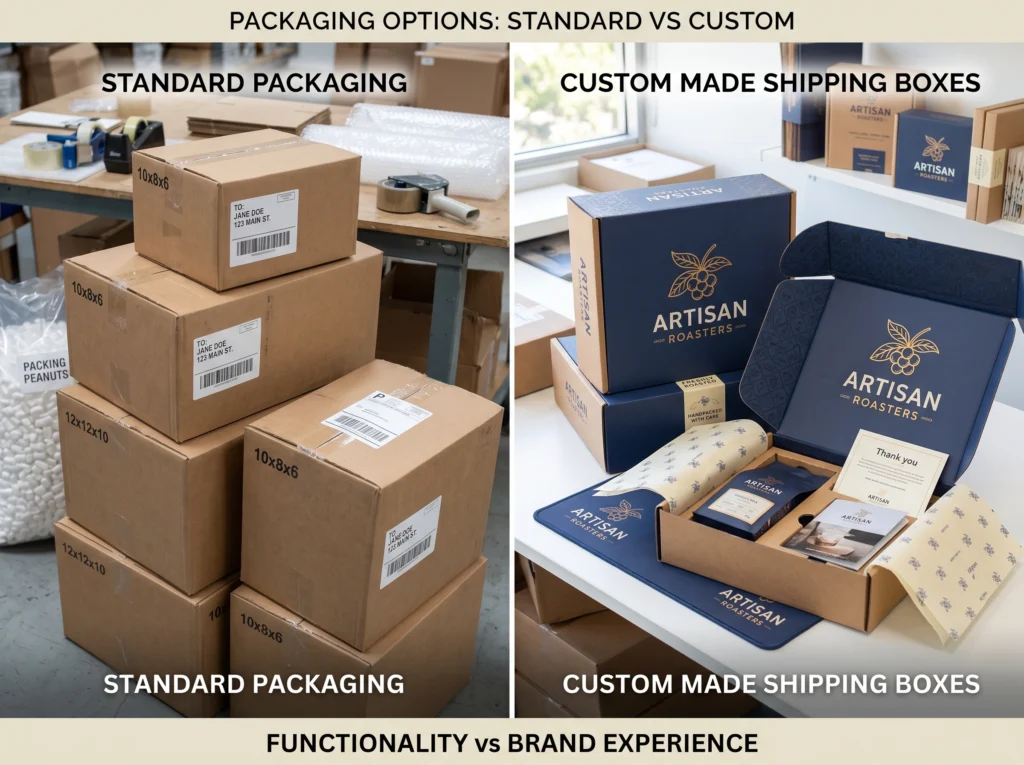
Custom made shipping boxes are purpose-built for a specific brand featuring custom dimensions, printed branding, and chosen materials. Standard packaging is off-the-shelf, generic, and available with no lead time. Custom boxes win on brand experience, shipping cost savings, and sustainability. Standard packaging wins on speed, zero MOQ, and low upfront cost. The right choice depends on your order volume, budget, and how much brand identity matters to your business.
The Box You Ship In Is a Business Decision Not Just a Logistics One
Picture two packages arriving at a customer’s door on the same afternoon. One is a plain brown corrugated shipping box, taped shut, no markings. The other is a clean, fitted branded shipping box with the company’s colors, a custom interior print, and a self-locking close no tape needed. Same product inside. Completely different first impression.
That difference is not accidental. It is a deliberate choice between custom made shipping boxes and standard packaging and in 2026, that choice has real consequences for your brand loyalty, your shipping cost optimization, and your bottom line.
This guide breaks down every angle: cost, protection, sustainability, design trends, and exactly when each option makes the most sense for your business.
What Are Custom Made Shipping Boxes?
Custom made shipping boxes also called bespoke shipping boxes or custom packaging boxes are packaging solutions engineered specifically around your brand and your products. You define every detail:
- Exact dimensions tailored to your product’s size and weight
- Material selection from corrugated shipping boxes to kraft boxes and specialty substrates
- Print design your logo, brand colors, typography, and messaging
- Structural style tuck-end, self-locking mailer boxes, two-piece rigid, or custom mailer boxes
- Finish matte lamination, spot UV, braille embossing, or uncoated natural stock
Industries that depend heavily on custom packaging boxes include DTC (direct-to-consumer) beauty brands, subscription box companies, consumer electronics, luxury apparel, artisan food producers, and health and wellness brands.
What Is Standard Packaging?
Standard packaging also known as stock packaging or generic packaging is manufactured in fixed sizes and available immediately, with no customization. Common formats include:
- Regular Slotted Containers (RSC) the classic brown box
- Poly mailers for soft goods and clothing
- Padded envelopes for books, small electronics, and flat items
- USPS flat-rate boxes and carrier-provided shipping options
Standard packaging is the default for early-stage startups, B2B shippers, industrial logistics, and businesses testing new product lines. Zero design lead time, no minimum order quantity (MOQ packaging), ready to ship today.
Every Factor That Matters
Factor 1: Brand Identity and the Unboxing Experience
Custom packaging wins decisively here. Brand identity packaging in 2026 is one of the highest-ROI marketing investments a product brand can make. A well-designed branded shipping box communicates quality before the customer opens it, creates an emotional connection, and drives repeat purchases.
The unboxing experience has become a genuine customer acquisition channel. Unboxing video packaging shared on social platforms generates organic reach that no paid ad can replicate. A frustration-free packaging design one that opens cleanly, fits the product snugly, and looks intentional earns shares and five-star reviews.
Standard packaging delivers none of this. A plain brown box communicates nothing about your brand. It is purely functional.
Winner: Custom packaging no competition.
Also Read: What Are Collapsible Rigid Boxes?
Factor 2: Shipping Cost Optimization and Dimensional Weight
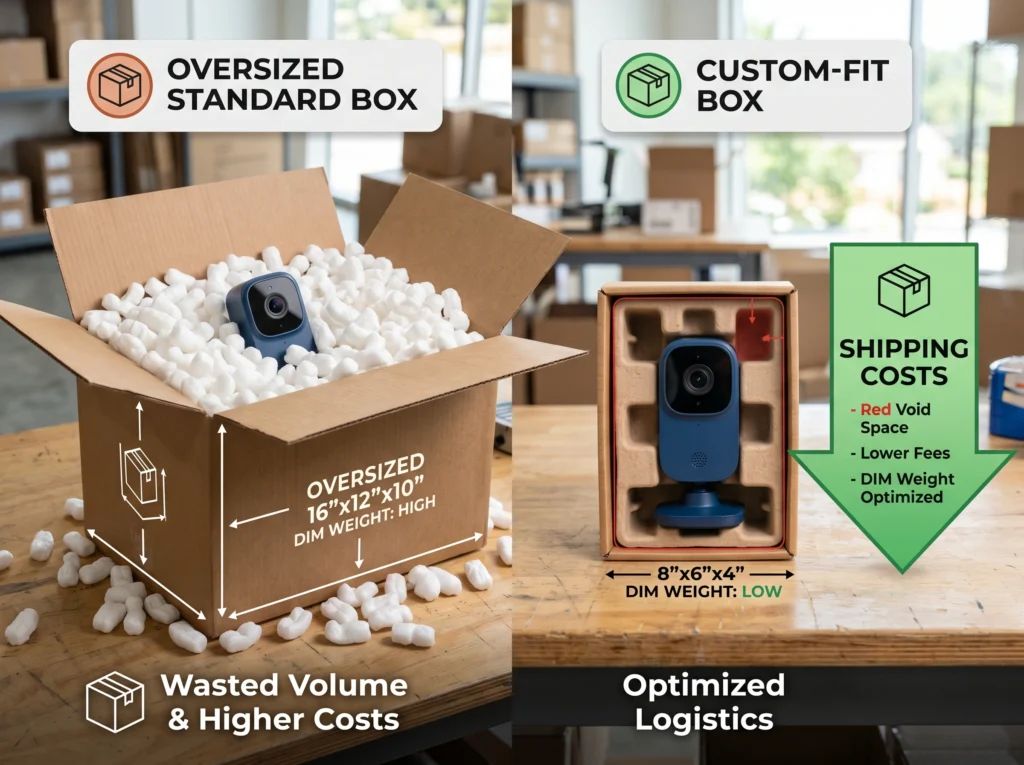
This is the factor most businesses overlook until they see their carrier invoices. Custom made shipping boxes built to your product’s exact dimensions eliminate wasted space and wasted space is expensive.
Carriers like UPS and FedEx charge based on dimensional weight fees a calculation that uses the box’s length × width × height divided by a carrier divisor. An oversized box costs the same to ship as a much heavier package. Right-size packaging closes that gap.
Real-world impact:
- Reduced dimensional weight fees on every shipment
- Less void fill materials (bubble wrap, packing peanuts, air pillows) needed
- Lower damage rates products that fit their box move less in transit
- Makes free shipping offers financially viable at lower price points
Roughly 30% of businesses report product losses from inadequate packaging. Getting the fit right is one of the most cost-effective operational improvements available.
Standard packaging forces you into the nearest available size often too large. More fill, more weight, higher fees.
Winner: Custom packaging for established volumes. Standard packaging for early-stage when volume is unpredictable.
Factor 3: Upfront Cost, MOQ, and Lead Time
This is where standard packaging earns its place:
| Custom Made Shipping Boxes | Standard Packaging | |
|---|---|---|
| Upfront cost | Higher setup + design fees | Low pay per unit |
| MOQ requirement | Yes typically 50–500+ units | None |
| Lead time | 2–4 weeks (first order) | Same day / next day |
| Per-unit cost (high volume) | Lower | Higher per unit |
| Design flexibility | Full control | None |
| Availability | Planned only | Immediate |
| Brand impact | High | None |
| Eco-material options | Full control | Limited |
| Dimensional weight savings | Yes | Rarely |
| Best for | Established DTC, subscription, luxury | Startups, B2B, short-run |
Digital short-run printing has changed the economics significantly. In 2026, custom packaging boxes are available in runs as low as 50–100 units, removing the biggest financial barrier for smaller businesses. A kraft box with black ink in a standard structure costs a fraction of full-color premium designs and still delivers enormous brand lift over a plain brown box.
Winner: Standard packaging for speed and zero commitment. Custom packaging for volume and brand ROI.
Factor 4: Sustainability and Eco-Friendly Materials
Sustainable packaging 2026 is no longer optional. Customers expect eco-conscious choices, and regulatory pressure is increasing alongside it. The demand for bespoke shipping boxes made from recyclable and biodegradable materials is growing rapidly.
Custom packaging gives you complete control over your material story:
- Recyclable packaging made from post-consumer recycled content
- Biodegradable packaging materials plant-based films, mushroom packaging, seaweed wraps
- Kraft boxes and kraft-based options that eliminate bleached materials
- Water-based inks with no volatile organic compounds
- Mono-material structures designed for single-stream recycling
- Compostable packaging tape replacing petroleum-based adhesives
- Molded pulp trays replacing expanded polystyrene foam inserts
Circular packaging design is the 2026 headline trend brands are designing reusable shipping boxes built to be returned or repurposed. Some convert into storage containers or planters, giving packaging a second life that builds genuine brand goodwill.
A survey found 67% of customers will pay more for sustainable packaging. That is not a niche preference it is a mainstream buying signal.
Standard packaging rarely gives you meaningful control over materials. Off-the-shelf stock is made for cost, not environmental performance.
Winner: Custom packaging by a wide margin.
Factor 5: Product Protection
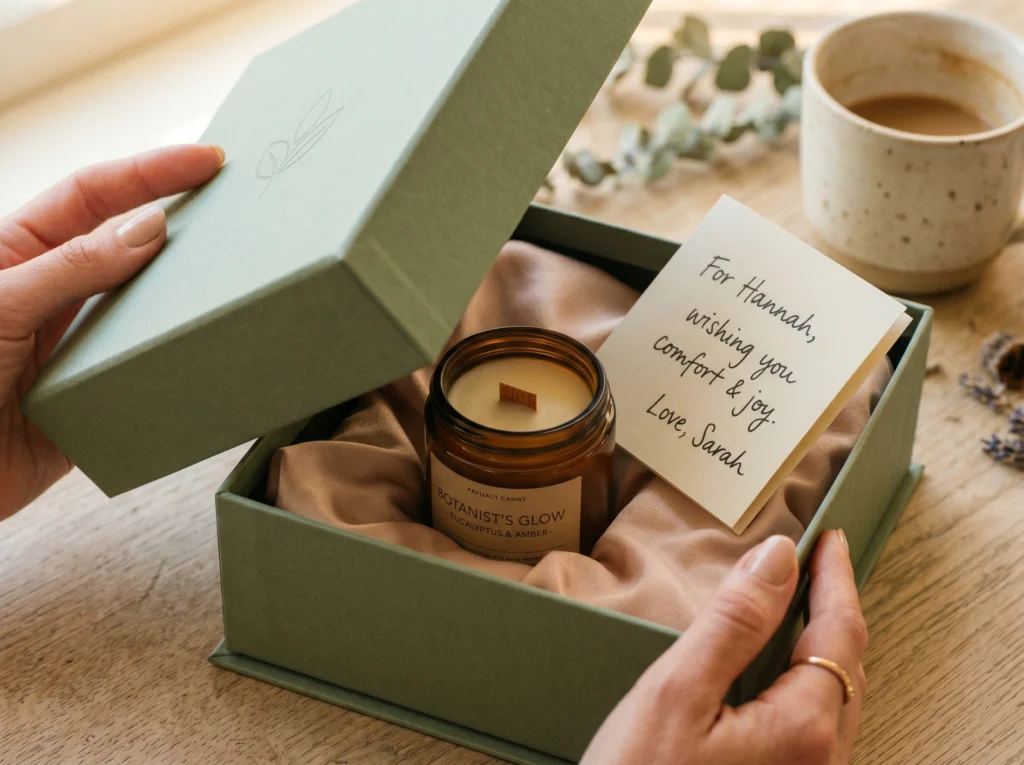
A box engineered to your product’s dimensions protects it better. This is not a branding argument it is a physics argument.
- Corrugated shipping boxes built to spec provide exactly the crush resistance your product needs no more cardboard than necessary, no wasted space that lets contents shift. Custom made shipping boxes also allow for integrated molded pulp trays, internal partitions, foam inserts, and structural features that no stock packaging can offer off the shelf.
- Standard packaging used correctly with proper void fill materials and cushioning absolutely protects products. But the added fill increases package weight, shipping cost, and packing time. It also generates more landfill waste per shipment.
- Winner: Custom packaging for fragile or high-value items. Standard packaging adequate for durable, low-value goods.
Factor 6: 2026 Packaging Trends Shaping the Decision
The biggest retail packaging trends in 2026 include sustainable packaging materials, custom and personalized packaging, smart packaging technology, minimalist design, omnichannel-ready packaging, and interactive unboxing experiences.
- Minimalist packaging design is dominating search and purchase behavior. Less ink, cleaner structure, more white space customers read minimalism as premium.
- Lightweight luxury packaging lets high-end brands deliver an upscale experience without heavy materials. The trend is toward packaging that feels premium but uses lighter, more sustainable materials letting luxury brands enhance customer experience without contributing excess waste or inflated shipping costs.
- Translucent packaging and window packaging boxes are seeing a 10–15% lift in search queries, especially in beauty and electronics. When customers can see the product, returns drop and conversions increase.
- Smart packaging technology QR codes, NFC chips, augmented reality triggers turns a physical box into a digital touchpoint. Customers scan packaging to access tutorials, loyalty programs, reorder links, and brand stories. Standard packaging cannot participate in this at all.
- Accessible packaging design and inclusive packaging design 2026 are becoming non-negotiable. Easy-to-open structures, large-format typography, and braille embossing make packaging work for every customer including the 1.3 billion people globally living with some form of disability.
- Self-locking mailer boxes that eliminate excessive tape are growing fast. A clunky tape job is a fail in the age of social media intuitive, clean-opening packaging earns the unboxing video.
- Custom hat shipping boxes and other specialty formats are rising as apparel brands solve the dimensional weight problem for odd-shaped products while maintaining a sharp visual identity.
When to Choose Custom Decision Guide
Choose custom made shipping boxes when:
- Your brand is a meaningful part of why customers buy from you
- Your products have a consistent shape and volume that justifies tooling
- You are shipping 100+ units per month and per-unit economics are improving
- You sell in DTC, beauty, wellness, subscription box, luxury, or electronics categories
- You want to meaningfully reduce dimensional weight fees
- Your sustainability commitments need to be visible and verifiable
- You want unboxing video packaging that earns organic reach
- You are building long-term customer retention and brand loyalty
Stick with standard packaging when:
- You are in the first 3–6 months of a new product launch
- Order volume is under 50–100 units per month
- You are running a short-term or seasonal campaign
- You are a B2B shipper or industrial fulfillment operation
- Speed and zero lead time are your highest priority
- Budget constraints make upfront custom costs genuinely unworkable right now
There is no wrong answer here only the right answer for your current stage.
The Smart Transition: Moving From Generic to Custom Packaging
Most successful brands start with stock packaging and upgrade when the business justifies it. Here is a practical, staged path:
- Measure first. Identify your top 3–5 product SKUs by shipment volume. Only those warrant early investment in custom tooling.
- Start value-first. A kraft box with black ink in a near-standard size is a significant brand step up at minimal cost. This is the fastest way to test branded e-commerce packaging without a full design budget.
- Test rigorously. Order samples and run them through your real packing and shipping environment. Check for structural integrity, damage rates, and team packing speed.
- Add one upgrade at a time. Logo first. Brand color second. Premium interior print third. Let the packaging ROI at each stage fund the next one.
- Track what changes. Monitor return rates, customer satisfaction scores, and repeat purchase rates before and after each upgrade. The data will tell you exactly where the investment is working.
The Real Bottom Line
Custom made shipping boxes and standard packaging are not in competition they are tools for different stages of business growth.
When you are starting out, stock packaging is the rational choice. When your brand has traction, your order volume is consistent, and your customers’ experience matters to your growth, custom packaging stops being an expense and becomes one of the highest-leverage investments in your business.
The brands winning in e-commerce packaging in 2026 are not the ones with the biggest budgets. They are the ones that understood earliest that the box is part of the product.
Ready to make that upgrade? ONO Custom Boxes builds custom mailer boxes, corrugated shipping boxes, and eco-friendly packaging solutions designed around your brand, your product, and your budget.
Frequently Asked Questions
Are custom made shipping boxes worth the cost for small businesses?
Yes especially with digital short-run printing now making runs of 50–100 units accessible. A basic branded kraft box costs very little more per unit than plain stock and delivers significant brand lift. Calculate your dimensional weight savings over 6 months and the ROI often surprises.
What is the difference between custom and bespoke packaging?
The terms are used interchangeably in the industry. Both refer to packaging solutions built to a brand’s specific dimensions, materials, and design. “Bespoke” is more common in UK markets; “custom” in North America.
What is dimensional weight and why does it matter?
Dimensional weight fees are carrier charges based on a package’s volume length × width × height rather than its actual weight. Standard packaging boxes are often oversized, triggering these fees on every shipment. Right-size packaging engineered to your product eliminates this waste.
What are the best sustainable packaging options in 2026?
Leading choices include biodegradable packaging materials (plant-based films, seaweed wraps), recyclable packaging from post-consumer content, kraft-based options, water-based inks, mono-material structures, and compostable packaging tape. Circular packaging design boxes engineered to be returned and reused is the fastest-growing category.
How do I calculate packaging ROI before committing to custom boxes?
Compare: current per-unit shipping cost (including dimensional weight surcharges) vs. projected cost with right-sized custom boxes. Add reduced damage/return costs. Add estimated lift in repeat purchase rate from improved brand experience. Subtract the per-unit premium of custom over stock. Most brands with 200+ monthly shipments see positive ROI within 60–90 days.
What packaging trends should I follow for 2026?
The highest-impact trends are sustainable packaging, minimalist packaging design, self-locking mailer boxes, circular packaging design, smart packaging technology with QR/NFC integration, accessible packaging design, lightweight luxury packaging, and translucent packaging for visibility-driven categories.