
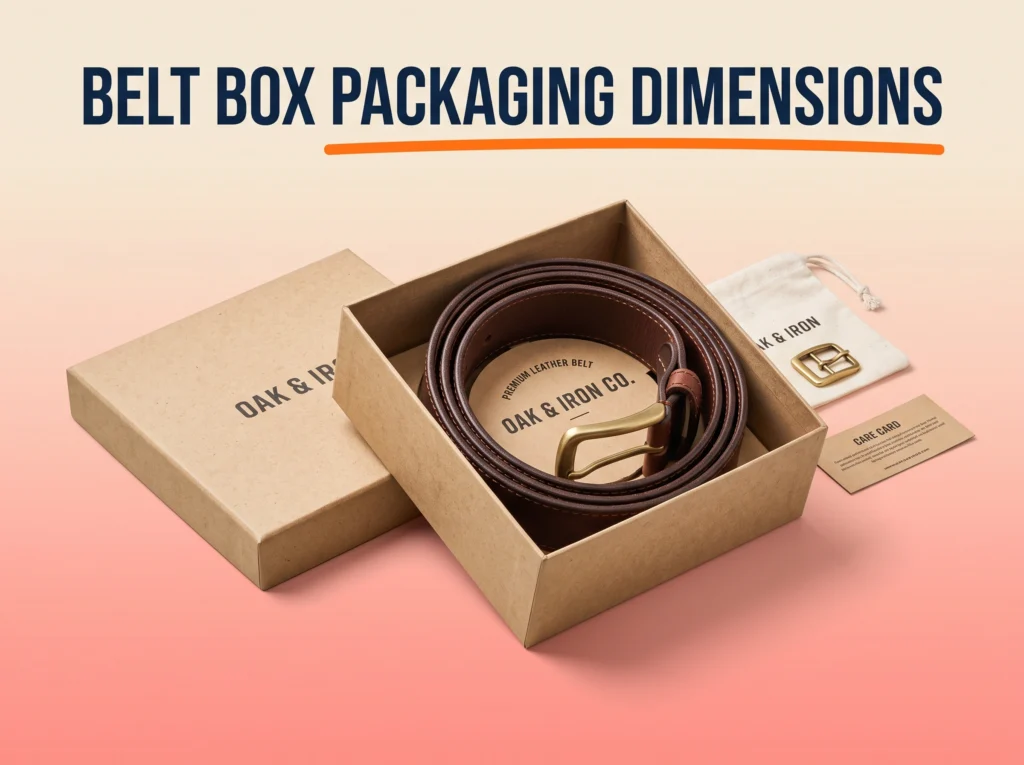
Picking the right belt box dimensions is the easiest way to make your belts look premium, ship safely, and save money on materials. Whether you sell one belt at a time or ship multi-packs, the right box size keeps your product snug, protected, and shelf-ready.
This friendly guide walks you through standard sizes, how to measure your belt, and how to choose custom dimensions with total confidence. Let’s dive in!
Standard Belt Box Sizes
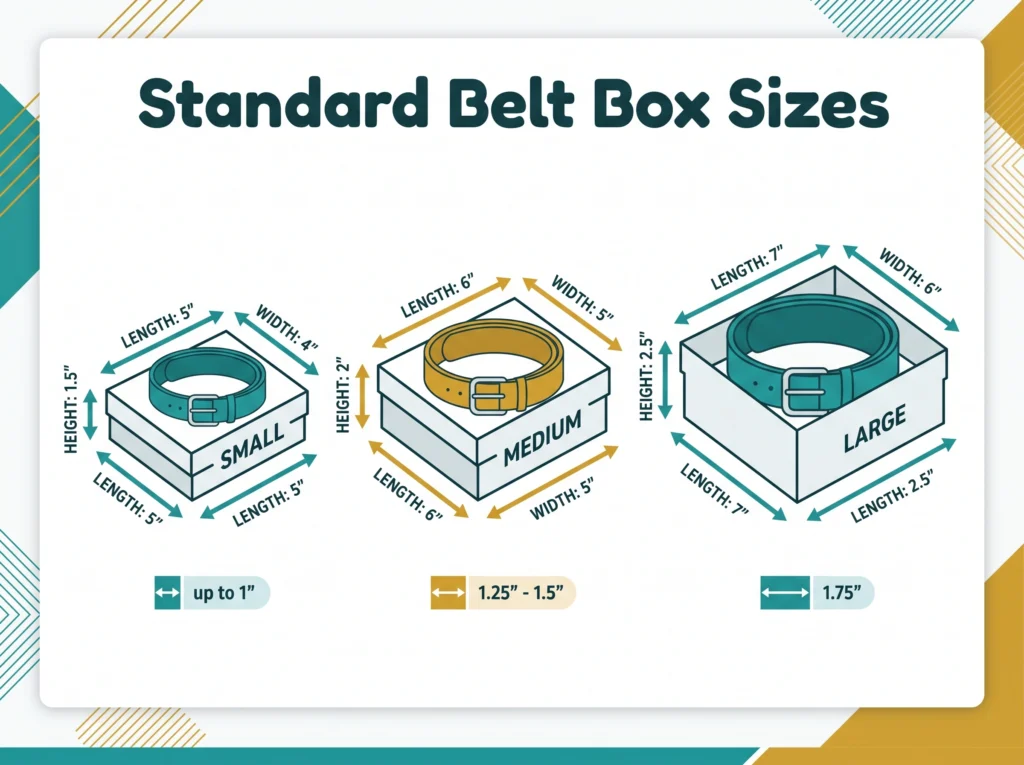
If you just want the numbers, here they are. These are the most common belt packaging sizes used across the industry:
| Pack Size | Common Dimensions (L × W × H) | Best For |
|---|---|---|
| 1 belt (folded) | 3.5 × 3.5 × 2.75 inches | Single dress or casual belts |
| 1 belt (coiled) | 5 × 5 × 2.5 inches | Rolled leather belts with buckle bulk |
| 6 belts | 13.83 × 6.52 × 5.51 inches | Retail multi-packs |
| 8 belts | 12.6 × 12.6 × 3.6 inches | Bulk display or gift sets |
| Standard metric | 90 × 90 × 70 mm (30mm lid) | Universal single-belt rigid box |
Good to know: These are starting points. Belts vary in width, length, and style, so your custom belt box size should always be measured against your actual product.
Why Belt Box Dimensions Matter So Much
A belt is flexible, but its packaging needs structure. Get the size right and your box dimensions for belts will do three jobs at once:
- Protect the product. Correct sizing stops belts from bending, creasing, or tangling in transit.
- Look premium. A snug fit signals quality the moment a customer picks up the box.
- Save money. The right dimensions reduce wasted material and cut down on void fill.
When you use rigid stock, cardboard, or kraft in the correct size, your belts arrive in perfect shape and your brand makes a strong first impression.
What Trips People Up
If you have felt stuck picking a box size, you are in good company. Here are the most common hurdles buyers face, and the quick fix for each:
- “I didn’t know standard sizes existed.” Now you do! Start with the size chart above.
- “My belts are all different widths.” Measure your widest, longest belt and build from there.
- “Inches or millimeters?” Pick one unit and stick with it when you request a quote.
- “How tall should the box be for the buckle?” Add extra box height to account for buckle bulk.
- “What about multi-belt packs?” Use dividers or inserts and scale up length and width, not just height.
- “I’m afraid of ordering the wrong custom size.” Order a free sample or 3D mock-up first.
- “What info does the supplier even need?” Give them belt length, width, buckle depth, and pack count.
How to Measure a Belt for Packaging
Getting your belt box specifications right starts with measuring the belt itself. Follow these simple steps:
- Measure the belt length. Lay the belt flat and measure from the buckle edge to the tip. Note whether you will fold or coil it.
- Measure the belt width. Standard belts run 1 to 1.5 inches; designer and work belts can be wider.
- Measure the buckle depth. This decides your box height (L × W × H), since the buckle is the bulkiest part.
- Decide the presentation. Folded belts need a squarer box; coiled belts need a round-friendly footprint.
- Add a little breathing room. Include a small buffer so the belt slides in and out with ease.
Pro tip: Always double-check your L × W × H orientation so the supplier reads your belt box template correctly. Length is longest, width is second, height is the depth.
Standard vs. Custom Belt Box Dimensions
So, should you go standard or custom? Here is a simple side-by-side to help you choose:
| Feature | Standard Sizes | Custom Sizes |
|---|---|---|
| Cost | Lower upfront | Slightly higher, but efficient |
| Fit | Good for common belts | Perfect fit for any belt |
| Speed | Faster to order | Needs a mock-up first |
| Branding | Basic | Fully tailored |
| Best for | Startups, small batches | Growing and luxury brands |
Standard sizes are great when you are testing the market. Custom belt box dimensions shine once you know your product and want that flawless, glove-like fit that elevates the unboxing experience.
Choosing the Right Material for Your Box Size
Your belt box dimensions and your material work together. Bigger boxes and heavier belts need sturdier stock. Here is a quick guide:
- Kraft: Lightweight, eco-friendly, and great for slim single-belt boxes.
- Cardboard (cardstock): Durable and budget-friendly for everyday retail packaging.
- Corrugated stock: Extra strength for multi-belt packs and long-distance shipping.
- Rigid stock: Premium and luxurious, perfect for designer belts and gift boxes.
Box gauge (thickness) usually ranges from 8pt to 28pt. Thicker stock supports more weight, so scale it up as your box size and belt count grow.
Popular Belt Box Styles (and How Size Affects Them)
The right style pairs beautifully with the right dimensions. Here are crowd favorites:
- Tuck-end box: Simple, slim, and ideal for single belts.
- Sleeve box: A sliding sleeve that adds a refined touch.
- Two-piece (lid and base) box: Timeless and elegant for gifting.
- Drawer box: A slide-to-reveal design that feels premium.
- Magnetic closure box: Sleek, modern, and great for the unboxing moment.
- Foldable rigid box: Space-saving luxury without the bulk.
- Window box: Shows off the belt while keeping it protected.
Each style may shift your ideal box dimensions slightly, so confirm the internal size fits your belt snugly.
Do You Need Inserts or Dividers?
For multi-belt packaging, inserts and dividers are your best friends. They:
- Keep each belt neat and separated
- Prevent tangling and scratching
- Make the box look organized and professional
- Add structure that supports your chosen dimensions
Die-cut inserts are worth the small extra cost, especially for retail-ready and gift packaging.
Sustainability: Right-Sizing Saves the Planet Too
Here is a happy bonus: choosing accurate belt box dimensions is also an eco-friendly move. A right-sized box means:
- Less wasted paperboard
- Less void fill and filler material
- Lower shipping weight and emissions
- Recyclable, biodegradable options like kraft and cardboard
Smart sizing is a simple win for your brand and for the environment.
Quick Belt Box Sizing Checklist
Before you place your order, run through this handy checklist:
- Measured belt length, width, and buckle depth
- Decided folded vs. coiled presentation
- Chose your pack count (1, 6, 8, or custom)
- Picked a material that matches the size and weight
- Added breathing room to the internal dimensions
- Confirmed L × W × H orientation with your supplier
- Ordered a free sample or 3D mock-up
When you are ready to bring your design to life, teams like ONO Custom Boxes can help you turn your exact measurements into retail-ready packaging.
Frequently Asked Questions
What is the standard size for a belt box?
The most common single-belt box sizes are around 3.5 × 3.5 × 2.75 inches or 5 × 5 × 2.5 inches. A popular metric standard is 90 × 90 × 70 mm with a 30mm lid height.
What size box do I need for multiple belts?
Six-belt boxes often measure around 13.83 × 6.52 × 5.51 inches, while 8-belt boxes run about 12.6 × 12.6 × 3.6 inches. Add inserts to keep belts organized.
How do I measure a belt for packaging?
Measure the belt’s length, width, and buckle depth. Use the buckle depth to set your box height, and add a small buffer for an easy fit.
Can belt boxes be custom-sized?
Yes! Belts come in many widths and styles, so custom dimensions ensure a perfect, snug fit for any belt.
Inches or millimeters, which should I use?
Either works. Just pick one unit and use it consistently when you share your box dimensions with a supplier.
What material is best for belt boxes?
Kraft and cardboard suit slim, single-belt boxes. Corrugated and rigid stock are better for multi-packs, heavier belts, and luxury presentation.
How much breathing room should I add?
A small buffer of roughly a quarter inch on each side lets the belt slide in and out easily without looking loose.
Do belt boxes need inserts?
For single belts, inserts are optional. For multi-belt packs, dividers keep everything neat and prevent tangling.
Final Thoughts
Getting your belt box packaging dimensions right is a simple step that pays off in protection, presentation, and savings. Start with the standard belt box size chart, measure your product carefully, and choose custom dimensions when you want that perfect fit.
With the right size, material, and style, your belts will look their absolute best, and your customers will feel the quality the moment they pick up the box. Happy packaging!