
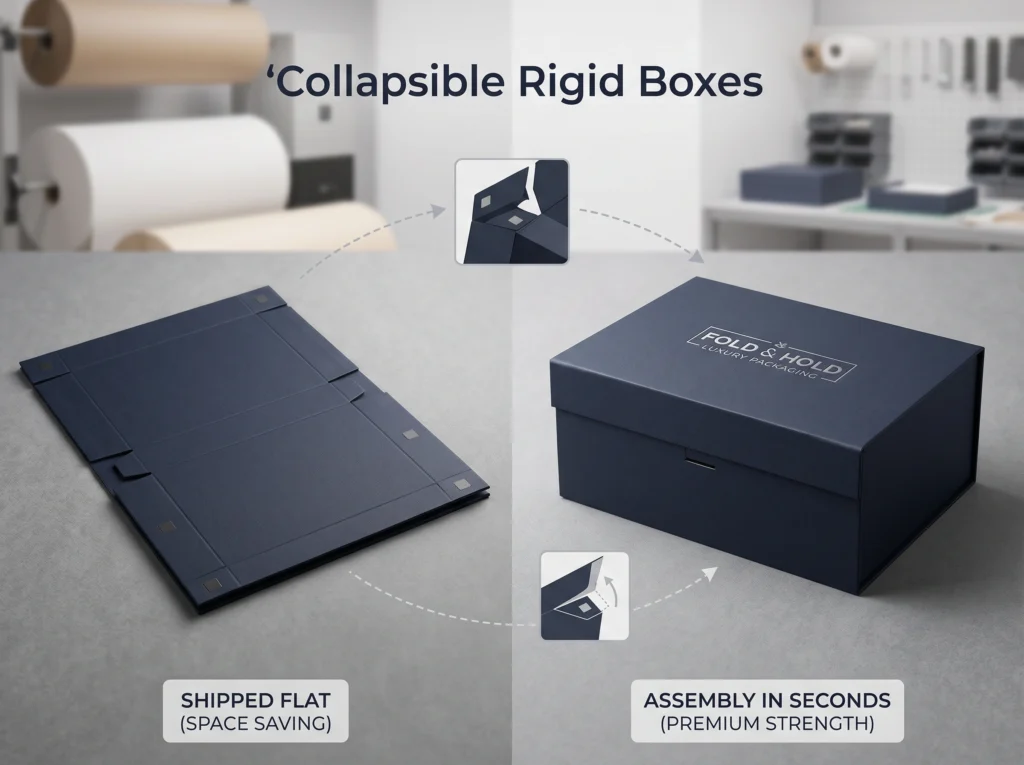
A collapsible rigid box is a premium, structured packaging box built from thick chipboard or greyboard (1mm–3mm) that folds completely flat for storage and shipping, then snaps into a rigid shape for use. It delivers the same look and feel as a traditional luxury rigid box while cutting freight and warehouse costs by up to 60%.
The Problem Every Product Brand Faces With Packaging
You have a beautiful product. You want packaging that reflects its value. But when the quote comes back for traditional rigid box packaging, the freight costs alone eat a significant share of your margin and that is before you factor in the warehouse space those pre-built boxes consume.
This is the exact challenge that made collapsible rigid packaging one of the fastest-growing segments in the global packaging market. The collapsible rigid containers market is valued at USD 0.69 billion in 2026 and is projected to reach USD 0.98 billion by 2035, growing at a CAGR of 3.9%. Brands are not switching because it is trendy. They are switching because the numbers work. Business Research Insights
What Is a Collapsible Rigid Box?
A collapsible rigid box also called a foldable rigid box, flat-pack rigid box, or collapsible set-up box is a premium packaging structure built from thick chipboard or greyboard board, wrapped in premium paper or specialty material. Unlike a traditional rigid setup box that is permanently fixed in shape, a collapsible rigid box is engineered with fold lines and bonded hinges so it can lie completely flat when empty and lock into a fully structured box when needed.
The assembly takes seconds. No tape. No tools. No confusion.
Packaging Expert Insight: The key structural difference is in how the corners are constructed. Traditional set-up boxes have corners glued permanently at the factory. Collapsible rigid boxes use a scored hinge system the corners fold out and lock under tension, creating the same rigidity without permanent adhesive at that joint.
How Are Collapsible Rigid Boxes Made? (Step-by-Step)
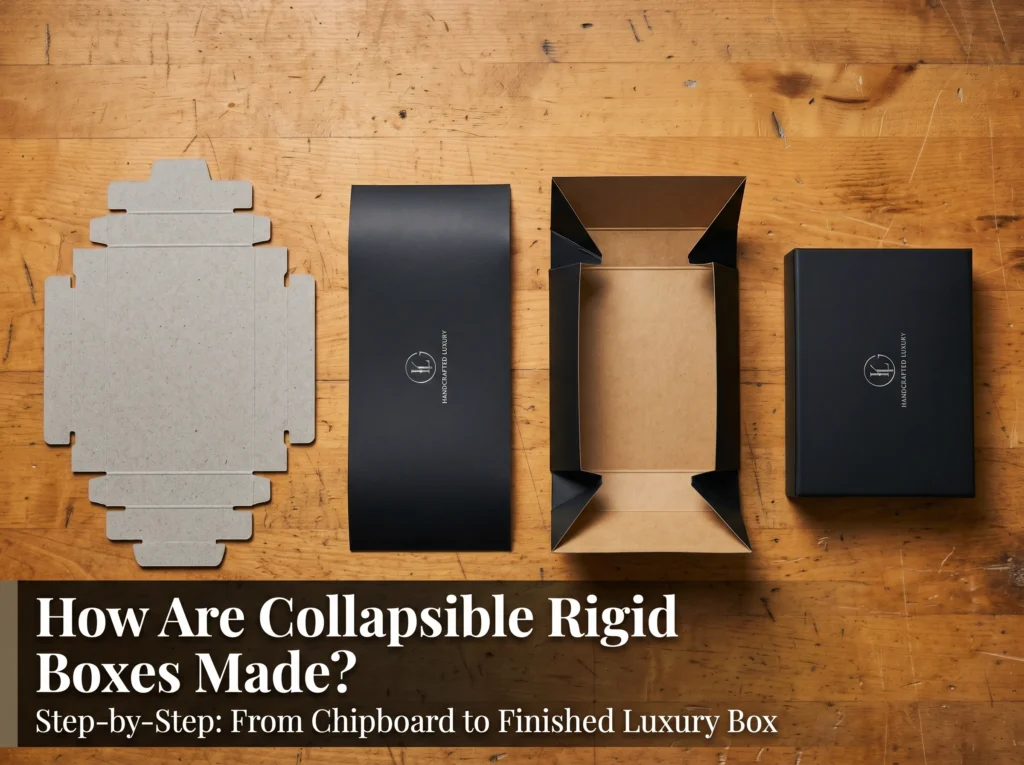
Understanding the manufacturing process helps you make better sourcing decisions and communicate more effectively with suppliers.
- Board selection and cutting The core material chipboard or greyboard, typically 1.5mm to 2.5mm thick for most retail applications is cut to size using precision die-cutting machinery. Heavier products may require 3mm board.
- Wrap material preparation The outer wrap premium paper, fabric, or specialty stock is printed using CMYK printing or Pantone spot color matching, then treated with the chosen finish: soft-touch lamination, UV coating packaging, linen texture, or plain gloss or matte.
- Surface embellishment Before or after lamination, decorative processes are applied: foil stamping (gold, silver, holographic), embossing to raise a logo or pattern, debossing to press it in, or spot UV coating for contrast gloss effects.
- Wrapping and scoring The printed and finished wrap is laminated onto the chipboard core. Score lines the fold points that allow the box to collapse are pressed into the structure at this stage with careful calibration.
- Hardware and inserts Magnet closures are embedded into the board before final assembly. Custom inserts, foam inserts, ribbon pulls, or drawer-style box sliding trays are fitted and tested.
- Quality check and flat-packing Each box is opened and closed multiple times to test hinge integrity, then folded flat for efficient palletizing and supply chain shipment.
Collapsible Rigid Box vs. Traditional Rigid Box vs. Folding Carton
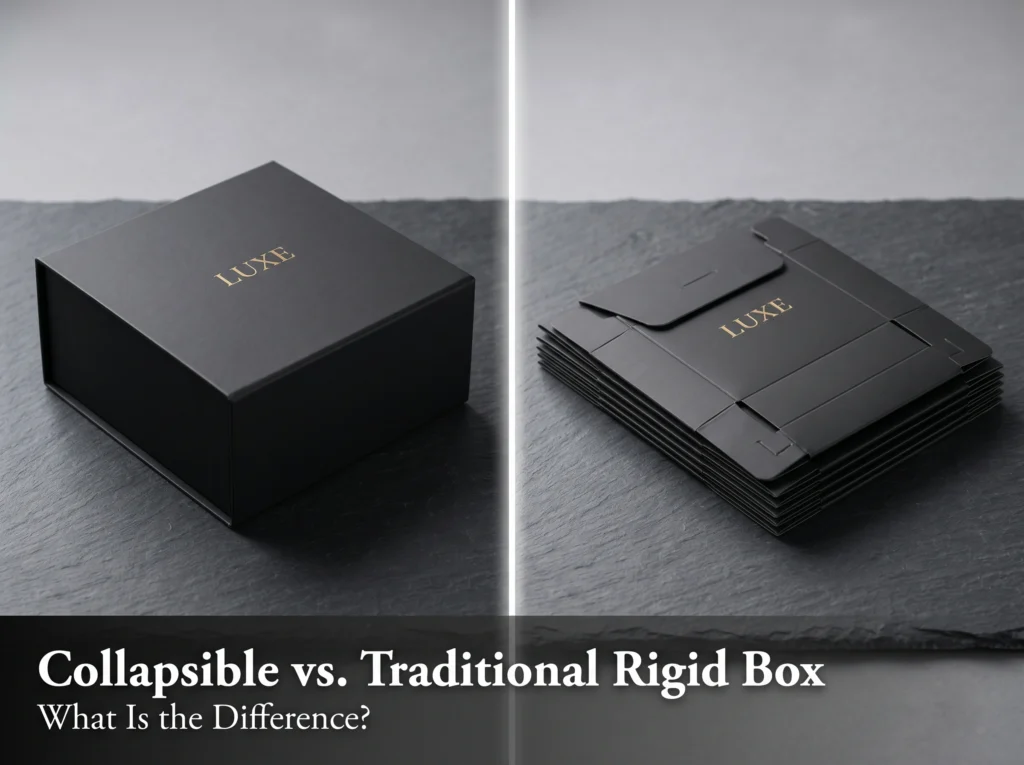
This is the most searched comparison in rigid box packaging, and the differences matter significantly for your budget, your brand, and your operations.
| Feature | Collapsible Rigid Box | Traditional Rigid Box | Folding Carton |
|---|---|---|---|
| Board thickness | 1.5mm – 3mm chipboard | 1.5mm – 3mm chipboard | 0.3mm – 0.6mm paperboard |
| Ships flat? | Yes | No | Yes |
| Assembly required? | Snaps open (seconds) | None pre-built | Fold and glue |
| Storage space | Up to 60% less | Full volume always | Minimal |
| Premium feel | High | High | Low–Medium |
| Freight cost | Lower | Higher | Lowest |
| Unboxing experience | Luxury | Luxury | Standard |
| Eco-friendly options | Yes | Moderate | Yes |
| Best for | E-commerce, D2C, gift, retail | Retail display, boutique | Mass market, FMCG |
Key takeaway: For brands shipping direct to consumers, the collapsible rigid box delivers luxury rigid box presentation at meaningfully lower logistics cost. The rigid box vs. folding carton difference is most visible in perceived product value customers who receive product in a rigid paperboard box consistently rate the brand higher in post-purchase surveys.
7 Reasons Brands Are Switching to Collapsible Rigid Packaging
1. Freight cost reduction of up to 60%
Flat-pack rigid boxes ship in dense stacks. These packaging structures deliver the premium unboxing experience customers expect while cutting shipping and storage costs by over 60% compared to traditional rigid boxes. For brands fulfilling hundreds or thousands of orders per month, this is a direct impact on margin.
2. Warehouse space recovery
Traditional set-up boxes occupy their full cubic volume in storage whether they are filled or empty. Collapsible rigid packaging stacks flat, freeing floor space for inventory, product, or operations.
3. Unboxing experience that builds brand loyalty
The unboxing experience is now a measurable brand metric. Campaigns that pair QR storytelling with structural reveals lift the tray, unlock a code, meet the brand creator show product page session times that are 5–8% longer and improved return-to-cart rates in the following seven days. The collapsible rigid box delivers the structural reveal that makes this possible.
4. Sustainability credentials that hold up to scrutiny
The latest trend centers on the rising adoption of bioplastics and recycled content, driven by sustainability concerns, with key players like CHEP and Schoeller Allibert leading development in this area. Eco-friendly rigid boxes built with recycled content and bioplastics are now available at commercially viable minimums. Flat-pack design also reduces the carbon footprint of transportation fewer trucks, fewer emissions per unit. Business Research Insights
5. Consumer-ready assembly
Custom collapsible boxes are trending because a brand can get the benefits of a rigid box with the extra advantage of the packaging being simple to store, and the boxes are generally simple to assemble, making life easier for businesses and consumers alike. Speedwaymedia
6. Full luxury customization nothing is sacrificed
Foil stamping, soft-touch lamination, linen texture finishes, magnet closure, custom foam inserts, embossing, debossing, spot UV coating every finish available on a traditional luxury rigid box is available on a foldable rigid box. Analysis of luxury rigid box trends for 2026–2027 shows a significant shift toward tactile finishes like soft-touch lamination and linen textures.
7. Scalable from small batch to rigid boxes wholesale
Whether you need 500 units for a product launch or 50,000 units for a retail rollout, collapsible rigid packaging scales. MOQ (minimum order quantity) thresholds have dropped significantly with improved manufacturing efficiency, making this format accessible to emerging brands, not just large ones.
Popular Collapsible Rigid Box Styles
| Style | How It Opens | Best Industry Use | Key Feature |
|---|---|---|---|
| Two-piece rigid box (Lid and base box) | Lift-off lid | Jewelry, cosmetics, electronics | Classic, clean, reusable |
| Book-style rigid box | Hinged like a book | Apparel, premium gifts, tech | Dramatic reveal, interactive feel |
| Drawer-style box | Inner tray slides out | Perfume, candles, accessories | Tactile, sequential reveal |
| Shoulder box packaging | Lift lid reveals interior rim | Beauty, luxury gifts | Layered, sophisticated look |
| Telescoping box | Deep-overlap lid and base | Heavy products, fragile items | Maximum structural strength |
| Magnetic closure box | Flip-front panel with magnet | Electronics, D2C subscription | Satisfying snap, reusable |
Who Uses Collapsible Rigid Boxes?

- Cosmetics and beauty: Skin care sets, foundation palettes, serum gift kits. The jewelry packaging segment uses them for ring boxes, bracelet sets, and watch presentations where structural protection and visual impact are both required.
- Perfume and fragrance: Bottle sets and limited-edition releases where the packaging is part of the product story.
- Electronics packaging: Earbuds, smart wearables, and accessories where the rigid paperboard box communicates product quality before the device is even seen.
- Food and beverage: Premium chocolates, curated tea sets, and gourmet gift packs for corporate gifting and retail-ready packaging displays.
- Pharmaceutical and wellness: High-end supplement kits, vitamin sets, and nutraceutical gift boxes where premium packaging signals product quality and earns consumer trust.
- Apparel and fashion: Folded scarves, belts, silk ties, and curated outfit boxes for D2C (direct-to-consumer) fashion brands.
- Subscription boxes: Monthly curated product drops where the unboxing experience is as important as the product inside.
- Corporate gifting: Personalized gift packaging for branded executive gifts, onboarding kits, and event packaging.
From the Packaging Floor: In cosmetics, the shift to collapsible rigid boxes has been especially sharp at the mid-tier price point brands priced between $30 and $120 per unit. Below that range, cost sensitivity pushes brands toward folding cartons. Above it, brands often prefer traditional set-up boxes for retail shelf presence. The sweet spot where foldable rigid boxes dominate is exactly where most growing D2C brands operate.
Customization Guide: What You Can Change, What You Cannot
What you can fully customize:
- Size and shape any dimension to the millimeter, including custom footprints
- Board thickness 1mm through 3mm chipboard or greyboard
- Outer wrap premium paper, fabric, kraft, specialty stock
- Print method CMYK printing, Pantone printing, digital, or screen
- Surface finish soft-touch lamination, gloss, matte, linen texture, velvet
- Embellishments foil stamping, embossing, debossing, spot UV coating
- Closure type magnet closure, ribbon tie, tuck flap, elastic band
- Interior plain board, paper lining, satin, velvet, foam inserts, custom inserts, thermoformed trays
- Branding rigid boxes with logo, printed interior, QR code unboxing integration
What affects cost most: Board thickness, surface embellishment quantity, insert complexity, and order volume relative to MOQ (minimum order quantity) all drive pricing more than base size.
At ONO Custom Boxes, structural prototypes are available before committing to a full production run so you can test the hinge feel, finish, and fit before placing your order.
Are Collapsible Rigid Boxes Recyclable?
This is a growing concern for brands making sustainable packaging commitments, and the answer is nuanced.
The chipboard core is recyclable in most municipal systems. The outer wrap depends on the lamination: uncoated or matte-laminated premium paper wraps are generally recyclable, while heavy soft-touch lamination or full foil coverage may need to be separated before recycling in some regions. Foam inserts are typically not curbside recyclable but can be disposed of separately.
For brands with formal sustainability targets, the best approach is to specify recycled content chipboard (widely available from responsible mills), choose water-based coatings over solvent-based, and limit metallic coverage to spot areas rather than full-surface. Bioplastic film options for lamination are also now available, though at a cost premium.
How Much Do Collapsible Rigid Boxes Cost?
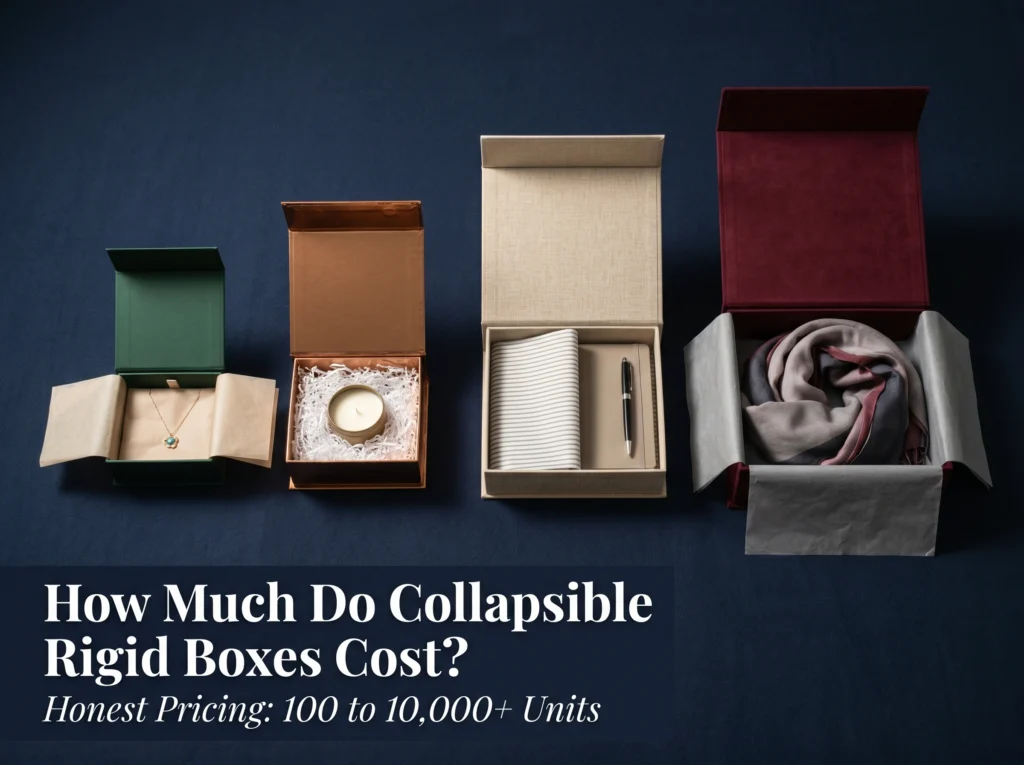
Pricing is the question every buyer wants a straight answer on. Here is an honest framework:
| Order Volume | Approx. Cost Per Unit (Standard Finish) | Notes |
|---|---|---|
| 100–500 units | $3.50 – $8.00 | Setup costs dominant; suitable for launches |
| 500–2,000 units | $2.00 – $4.50 | Most common D2C range |
| 2,000–10,000 units | $1.20 – $2.80 | Rigid boxes wholesale pricing begins here |
| 10,000+ units | $0.80 – $1.80 | Full production efficiency |
Add 15–40% for foil stamping, embossing, or magnet closure. Add 20–50% for complex foam inserts or thermoformed trays. Prices vary by region, supplier, and material market conditions.
The freight savings of switching from traditional set-up boxes to flat-pack rigid boxes typically offset the per-unit cost difference at volumes above 1,000 units per shipment.
Frequently Asked Questions
What is the difference between a collapsible rigid box and a folding carton?
A folding carton is made from thin paperboard (0.3mm–0.6mm) and has a lightweight, standard feel. A collapsible rigid box uses thick chipboard (1.5mm–3mm), feels substantially heavier and sturdier, and is associated with luxury packaging. The rigid box vs. folding carton difference is most apparent when the customer holds both the weight and rigidity of the rigid paperboard box communicates premium quality immediately.
How long does it take to assemble a collapsible rigid box?
Most foldable rigid boxes snap into shape in 3–10 seconds with one hand. Teams filling orders typically handle 200–400 units per hour depending on whether foam inserts or product placement is also involved.
Can collapsible rigid boxes be used for heavy products?
Yes. With 2.5mm or 3mm chipboard and a telescoping box or shoulder box packaging design, collapsible rigid packaging supports products weighing up to 4–5kg comfortably. For heavier items, a corrugated board outer shipper is recommended alongside the rigid box.
Are collapsible rigid boxes reusable?
Yes, and this is a key selling point. The hinge structure is engineered for repeated opening and closing typically 50–200 cycles before any wear is visible, depending on finish and handling. Many customers keep and reuse the box, which extends your brand’s physical presence in their home.
What is the minimum order quantity for custom collapsible rigid boxes?
Most manufacturers set MOQ (minimum order quantity) at 100–500 units for fully custom orders, with some suppliers offering lower quantities for digital printing. Rigid boxes wholesale pricing typically begins around 2,000–5,000 units.
How do collapsible rigid boxes support sustainable packaging goals?
Flat-pack shipping reduces transportation emissions per unit. Recycled content chipboard is widely available. Bioplastic lamination options exist. And the reusable nature of the box extends its lifecycle well beyond a single use each of these factors contributes to measurable reductions in packaging-related carbon footprint.
The Bottom Line
Collapsible rigid boxes solve a real operational problem the cost and bulk of traditional set-up boxes without asking brands to give up any of the luxury unboxing experience that builds customer loyalty and drives repeat purchase.
The structure works. The savings are measurable. The customization is complete. And with the collapsible rigid containers market growing steadily through 2035, the supply base is mature, competitive, and capable of delivering consistent quality at every volume level from startup launch to full rigid boxes wholesale scale.
If your product deserves packaging that performs as well as it looks, collapsible rigid packaging is worth a serious evaluation.