

Picture this: your new face cream finally launches. Orders roll in. Then an email lands your listing is suppressed because the label breaks a rule you never knew existed. Ouch.
Here is the good news. FDA labeling rules for creams are easier than they look. Once you know what belongs on each panel, you can design cream packaging that looks stunning and stays fully legal. This guide walks you through every step in plain English.
Quick answer: To design cream packaging that meets FDA labeling rules, your label must show the product identity, net quantity, ingredient list in INCI names, business name and address, any required warnings, and truthful claims placed on the correct panels with the correct font sizes under the FD&C Act and Fair Packaging and Labeling Act (FPLA).
Does the FDA Approve Cream Packaging? (The Truth)
Here is a fact that surprises many new brand owners. The FDA does not approve cosmetic label design before you sell. Instead, the law puts the duty on you. If your label misses required information, your cream is legally “misbranded” and misbranded products can be pulled from shelves, blocked at import, or flagged on Amazon.
So the smart move is simple: build compliance into your packaging design from day one, not after printing 5,000 boxes.
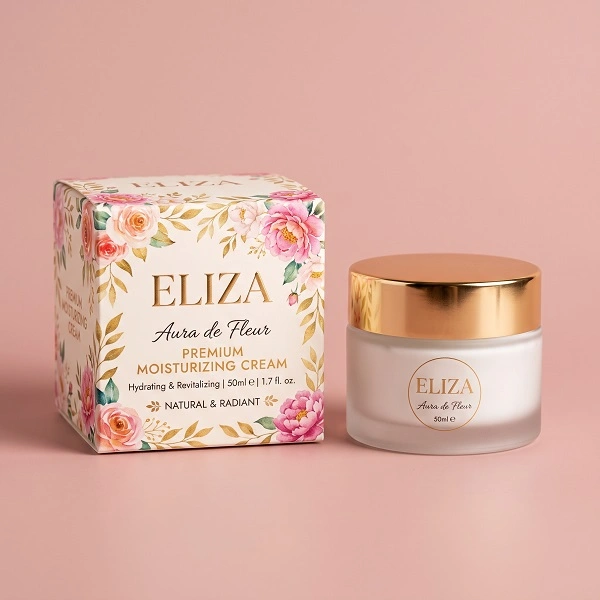
First Step: Is Your Cream a Cosmetic or an OTC Drug?
This single question shapes your whole label. It is also the number one confusion point for skincare founders.
- A cosmetic cream cleanses, beautifies, or improves appearance. Think moisturizers, anti-aging creams, and body butters.
- An OTC drug cream claims to treat or prevent a condition. Think acne treatment, eczema relief, or sunscreen.
Say “reduces the look of fine lines” and you have a cosmetic. Say “treats eczema” and you now need a full Drug Facts panel, an active ingredient listing, and drug rules. One word can change everything, so choose your cosmetic claims with care.
Cosmetic vs. OTC Drug Cream Labeling
| Label Element | Cosmetic Cream | OTC Drug Cream |
|---|---|---|
| Governing rules | FD&C Act + FPLA (21 CFR 701) | Drug regulations (21 CFR 201) |
| Ingredient format | INCI names, descending order | Active + inactive ingredients |
| Drug Facts panel | Not required | Required |
| Pre-market approval | No | Must follow an OTC monograph |
| Example claims | “Hydrates,” “smooths look of skin” | “Treats acne,” “relieves itch” |
| Registration | MoCRA facility registration | Drug establishment registration |
The 6 Must-Have Elements on Your Cream Label
Think of your label as two zones. The Principal Display Panel (PDP) is the front what shoppers see first. The information panel is usually the back or side. Each element has a home.
1. Identity Statement (PDP)
Tell people what the product is: “Hydrating Face Cream” or “Night Repair Cream.” Place it clearly on the front of your jar, tube, or box.
2. Net Quantity of Contents (PDP)
Your net quantity declaration must sit in the bottom 30% of the PDP. Use both US and metric units, like “Net Wt. 2 oz (57 g).” The FDA font size requirements tie the minimum type size to your panel area for most cream jars and folding cartons, that means at least 1/16 inch, and larger panels need bigger type.
3. Ingredient Declaration (Information Panel)
List every ingredient using INCI nomenclature in descending order by weight. Ingredients at 1% or less may appear in any order after the others. Color additives come last. Watch this space too: the FDA is working on fragrance allergen labeling rules under MoCRA, so leaving room in your layout now is a smart design move.
4. Name and Place of Business (Information Panel)
Show your company name and address. If you are not the maker, use a distributor statement such as “Distributed by.”
5. Warning Statements (When Required)
Some products need specific warnings under 21 CFR 740. If safety of an ingredient has not been fully tested, a warning is required. Design tip: never shrink warnings to fit your art regulators check this first.
6. MoCRA Contact Information
The Modernization of Cosmetics Regulation Act (MoCRA) now requires a US contact a domestic address, phone number, or electronic contact on the label so consumers can report adverse events. Many small brands still miss this one, which makes it an easy way for you to stand ahead.
Also Read: Cream Box Dieline and Size Guide (30ml, 50ml, 100ml Jars)
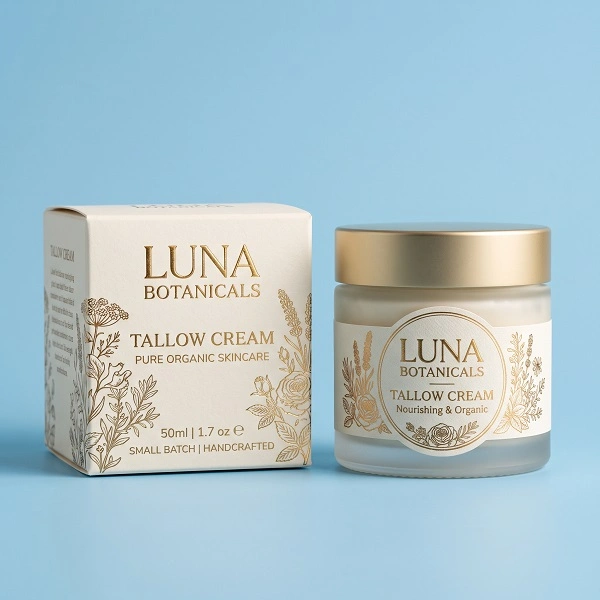
Design Tips: Where Regulation Meets Beautiful Packaging
Compliance does not mean boring. Here is how to keep your skincare packaging gorgeous and legal at the same time.
Plan text zones on your dieline first. Before choosing colors or artwork, block out space on your packaging dieline for the PDP identity, net quantity zone, and full ingredient list. Small 2 oz jars fill up fast, so map the space early.
Use the outer box wisely. When a jar is too small, the outer carton can carry the full ingredient declaration, while the inner jar still needs core information. A well-planned secondary packaging layout gives your designer breathing room and this is exactly where a supplier like ONO Custom Boxes helps brands fit every mandatory element onto a compliant, print-ready cream box layout without crowding the design.
Test readability at real size. A label that looks fine on a 27-inch monitor may be unreadable on a 50 mm jar. Print a mockup and check every panel.
Keep claims clean. Words like “hypoallergenic” and “natural” are not defined by the FDA, but they must still be truthful, and the FTC watches marketing claims closely. “Organic” claims fall under USDA Organic rules. When in doubt, soften the claim “made with organic shea butter” is safer than “organic cream” without certification.
Leave room for trends. QR code labeling, refillable cream jars, and sustainable packaging call-outs are rising fast in clean beauty. Reserve a small zone on your layout so future updates never force a full redesign.
7 Common Labeling Mistakes That Trigger Trouble
- Making drug claims (“heals,” “treats”) on a cosmetic cream
- Placing the net quantity outside the bottom 30% of the PDP
- Listing ingredients by common names instead of INCI names
- Missing the MoCRA US contact information
- Printing type smaller than the minimum size rules allow
- Skipping the ingredient list on the outer box when it is the display container
- Using unproven claims like “FDA approved” cosmetics are never FDA approved
Fixing these before print protects you from misbranding issues, import refusals, and marketplace takedowns.
Your Pre-Print Compliance Checklist
Run this quick check before you approve artwork:
- Identity statement on the PDP
- Net quantity in the bottom 30%, dual units, correct type size
- Full INCI ingredient list in descending order
- Business name, address, and distributor statement
- Required warnings at proper size
- MoCRA-compliant adverse event contact
- Claims reviewed no drug language on a cosmetic
- Real-size print proof reviewed
Frequently Asked Questions
Does the FDA approve cream packaging before sale?
No. The FDA does not pre-approve cosmetic labels. You are responsible for making sure your cream label follows the FD&C Act and FPLA before selling.
What information is legally required on a cream label?
A cream label needs the product identity, net quantity of contents, ingredient list, business name and address, required warnings, and a US contact for adverse event reports under MoCRA.
What font size does the FDA require on cosmetic labels?
The minimum type size depends on your panel area. For most cream jars and boxes, the net quantity must be at least 1/16 inch tall, with larger sizes required for bigger panels.
Do ingredients go on the jar or the outer box?
The ingredient list belongs on the outside container that shoppers see at purchase. If your cream sells in a box, the box must carry the full list.
Can I write “organic” or “natural” on my cream packaging?
Yes, if truthful. “Organic” claims must follow USDA Organic standards, and “natural” claims must not mislead buyers, since the FTC reviews marketing claims.
What is MoCRA and how does it affect cream labels?
MoCRA is the 2022 cosmetics law that requires facility registration, product listing, and a US contact on labels for adverse event reporting.
Do imported creams need FDA-compliant labels?
Yes. Any cream sold in the USA must meet the same FDA labeling requirements, and non-compliant imports can be refused at the border.
Is “cruelty-free” regulated by the FDA?
No official FDA definition exists, but the claim must still be honest, so keep records that support it.
Final Thoughts
Designing FDA-compliant cream packaging is really about planning. Sort your product type first, map every required element onto your dieline, keep claims honest, and proof at real size. Do that, and your packaging will protect your brand while it wins hearts on the shelf. Your beautiful, fully compliant cream launch is closer than you think.